Category Archives: Geek

Fisheye Macro!


So one 1st of June I missed the company bus and got on the LRT instead, to work, and found flowers opposite Sogo, on the way to Bandaraya LRT!


I shot with either my Minolta 50mm F1.4 with Tamron 1.4x teleconverter…


…or the Peleng 8mm F3.5 circular fisheye.


Aperture plays a very important part in making a shot; make sure there is enough depth of field to make the flower sharp and defined as one object. Sometimes it also helps to not entirely throw the background into a blurry mess.


Wireless flash from below.


Also, I had to watch out for the sun and my shadow blocking it, especially so with a fisheye.


Annoyingly, the Peleng has an unevenly colored coating, where the color cast can change by just turning it about. Its effect can even be seen in the viewfinder!

600mm F11!

This is a really backdated post.

I got myself a Cosina 70-210mm F2.8-4.0 Macro for Minolta/Sony A-mount for use on my Sony Alpha 100. This is also known as the famous Vivitar Series 1 70-210mm F2.8-4.0 Macro.

This has the same range as the Minolta 70-210mm F4.0 beercan lens I have, but it’s brighter at 70mm.

Cosina 70-210mm F2.8-4.0 apertures:
70mm onwards F2.8
85mm onwards F3.2
120mm onwards F3.5
150mm onwards F4.0

In comparison, the Cosina’s plus points are:
– brighter before 150mm
– has a focus limiter switch which is better than standard focus limiters
– focuses to 1:2.5x macro
– shorter and will fit in my bag with camera body attached
– can be used with my fussy Tamron 1.4x 4-element 5-pin teleconverter


210mm F4 with the Cosina.

The Cosina’s minus points:
– brightline bokeh is obvious
– chromatic aberration is easy to get, so you’d need to stop down to F5.6 for acceptable levels
– it’s a push-pull (no one-handed pinky finger zooming for me!)
– teleconverters exaggerate the spherical aberration and chromatic aberration

I won’t sell the beercan, because of its plus points:
– much better creamy bokeh
– sharp wide open, and superb at F5.6 and darker apertures
– teleconverters show that my beercan has very little spherical aberration or chromatic aberration so the image quality barely suffers


Cosina with the Tamron 1.4x to make 300mm F5.6.


Stopped down to F8 at 300mm.

So what’s special about the focus limiter switch on the Cosina?

It can lock the focus ring from:
– infinity to 2 meters (at this point focus is superbly fast because the gear ratio is different than in macro mode)
– 2 meters to 1.1 meters (when not at 210mm focal length)
– 2 meters to 0.84 meters (at 210mm focal length)
– infinity to 0.84 meters (no lock)

The locked range depends on where you lock it. It just prevents the ring from passing the 2 meter mark.

This is much better than a standard focus limiter on those big lenses, which let you choose either infinity to macro, or infinity to 2 meters.

This makes my encounters with Vivitar Series 1 lenses to total 3; I had the Cosina 19-35mm F3.5-4.5 for Pentax-AF K-mount (sold to Yee Wei), Vivitar Series 1 28-105mm F2.8-3.8 for Minolta/Sony A-mount, and of course this Cosina 70-210mm F2.8-4.0 for Minolta/Sony A-mount.

My run-ins with Vivitar also include the Vivitar 24mm F2.0 for Olympus Zuiko OM-mount, Vivitar 28-70mm F3.9-4.8 for Minolta MD-mount, and Vivitar 75-205mm F3.5-4.5 for Pentax K-mount with 2x matched teleconverter. I’ve never shot through the fungused 28-70mm, but I’ve touched a Vivitar 100mm F3.5 Macro and it was good.

I also got myself a Kenko Teleplus 4-element 8-pin 2x teleconverter for Minolta/Sony A-mount. This converter oddly changes my Minolta 50mm F1.4 into a 105mm F3.5 (though metering indicates a accurate 2-stop loss). Astoundingly, this works with all my lenses unlike my fussy Tamron 4-element 5-pin 1.4x teleconverter. Despite the warning that a teleconverter and lens will only work if the combined total is brighter or equal to F6.3 (e.g. F3.5 lens on a 2x teleconverter cannot be used), the 2x throws that rule out the window. I can use my Sony 18-70mm F3.5-5.6 lens (easily my darkest lens) at 140mm F11.

It is then that I learnt to appreciate the kit lens; it’s astounding even with the 2x teleconverter. Teleconverters expose the weakness of a lens and exaggerate it. The kit lens had little to no loss in quality… while the Minolta 50mm F1.4 just went super soft.

So what if I stacked my teleconverters together?


In order: Sony A100, Kenko Teleplus 2x MC4 teleconverter, Tamron 1.4x MC4 teleconverter, Cosina 70-210mm F2.8-4.0 lens. Accessories include generic right-angle finder and Sony HVL-F56AM flash. (I cannot stack the teleconverters in reverse due to a metal stub on the Tamron.)

You read that right – a 600mm F11!

No, wait.

A CCD-shift stabilized 600mm F11!

For under RM1000!

It lets me shoot at 1/60th of a second! It’s light as heck and fits in my tiny Lowepro Nova Mini AW camera bag. The beercan does, too, but a bit tightly.

So what about in-lens stabilization? Sorry, only certain Nikkor VR lenses can work with teleconverters (or, certain teleconverters work with Nikkor VR lenses). Haven’t read up on Canon’s though.

My Tamron 1.4x teleconverter is fussy, so while the beercan can also give 600mm F11 with better quality, it won’t be as practical.


Shot through a window in afternoon light. 600mm F16 1/60s ISO400.

The Sony A100 can only autofocus at F8 or brighter; at F11, this Cosina combo (which I will call the 600mm F11) is too full of spherical aberration when near focus, the camera cannot possibly focus.

Strangely, though, it is easier to manual focus. The lens feels great for manual focus, and when a black, backlit subject is out of focus, chromatic aberration leaks onto the black and turns it either purple or green. When the object is in focus, it is a solid black!

Alternatively, I could zoom out to 200mm F8 and auto-focus, then zoom in.

The 18-70mm F3.5-5.6 with 2x teleconverter at 140mm F11 is very easy to manual focus too; the entire image melts into spherical aberration softness, and it is very obvious when it is in focus. It feels like the outside matte surface of a split-prism viewfinder on ye olde Manual Focus SLRs. (Of which I have too many of.)


I later found a Tamron 2x 7-element 8-pin Minolta/Sony A-mount teleconverter, but I had already bought the Kenko! Ah heck, I tried it anyway for a 6x effect.


1200mm F22 1/80s ISO100. The camera reported an EXIF of 9999mm while my computer reported an EXIF of 65535mm. Apparently, it couldn’t count to 1200mm, heh. (Nearly focused) out-of-focus is pretty, and obvious.


1200mm F90 1/80s ISO400, still pretty stable. F90 is an errorneous number and it has the same focal length as the previous picture. I can’t remember if the CCD-shift was compensating like crazy.


My Minolta Dynax 7, Tamron 2x 7-element teleconverter, Kenko Teleplus 2x 4-element teleconverter, Tamron 1.4x 4-element teleconverter, Tamron 100mm F3.5 Macro lens. This famous lens allows close focus to 1:2 magnification, and 1:1 magnification with the supplied screw-on lens. This combo gives 3:1 magnification!


65535mm (actually, 100mm 2x 2x 1.4x 600mm) F51 1/125s ISO100. This is a speaker grille at Keat Camera.

Frankly, I found little difference in image quality between the 7-element Tamron and my 4-element Kenko. Results may vary.

So how far can the Sony A100 count?

1000mm.


1000mm F16 1/15 ISO1600. This was with the Sony 500mm F8 reflex mirror lens. It can still (try to) auto-focus! At such slow speeds it cannot be ascertained if it was handshake or motion blur.


500mm F8 1/13 ISO400. Look ma, no donuts! It is up to the photographer, once acquainted with a reflex mirror lens, to hide or emphasize donut-shaped bokeh.


Stopping down my 600mm F11 provided better results. It goes down to F64! At this point any dust on the sensor becomes small and manageable. This is also where I wish for an Olympus Super-Sonic Wave Filter anti-dust solution, because that’s the only one that really works. Shot at 600mm F64 1/160s ISO1600.


600mm F64 1/40s ISO400.


My pride. 600mm F11 1/2s ISO400. Half a second handheld! Handshake and softness is of course apparent, but the size of the subject makes it less relevant.


600mm F11 1/30s ISO1600. When I shot this I didn’t know that light in the sky was Venus. Or was it Saturn?


280mm F7.1; possibly the Cosina at 140mm with the 2x. Its brightline bokeh is very obvious here.


600mm F16 1/80s ISO400, for the birds. Any shorter focal length would need you to step closer… and the birds would fly away. This makes shooting in a bird park a lot easier because them birds don’t fly away.


600mm makes for espionage!


I spy smashpOp!


I spy my boss!


I spy on the police!


I spy the Fujifilm building!


Big macro zooms, left to right: Minolta Dynax 7 with Kenko 2x, Tamron 1.4x and Cosina 70-210mm F2.8-4.0 Macro; Pentax P30t with Vivitar 2x matched teleconverter with Vivitar 75-205mm F3.5-4.5; Olympus OM-2000 with Vivitar 2x teleconverter with Soligor 70-220mm F3.5 Macro.

Add 1:2.5x magnification with a 3x magnification from the teleconverters to get 3:2.5x or 1.2:1!

So where’s the customary shot of all my Minolta-mount lenses? It’s not here, because there’s yet another I didn’t mention, and another on its way. This isn’t even the last of the geek entries, I assure you that.

Major Geekout Time!

Sony has leaked several images on their site, hidden in news links somewhere. Anyway, they’re all at this link at Photoclub Alpha!

* I will refer to my Minolta Dynax 7 film SLR as the D7, and the Konica Minolta 7 Digital as the 7D.

What I love:
– Grip sensor (only when you are gripping the hand grip and look through the viewfinder, does Eye-Start Autofocus work, just like my D7.)
– Two dials like the D7 and 7D
– ISO, WB, Drive buttons
– AF/MF toggle button (this is different from an AF On button, because you can use it to switch from any AF mode to MF, or in MF mode to AF)
– metering mode knob (though I’m quite used to tapping AEL to toggle between multi-segment and spot metering.)
– (possibly) CMOS sensor. Now, the Sonys will have less noise! Sony is known for their cutting edge sensors, so we might see some Live View. Or not. No biggie.

What I like:
– Support for vertical grip, so people can stop complaining.

What I don’t like:
– missing EV dial and flash EV dial on top-left which goes -3 to +3 in half stops, or -2 to +2 in third stops (it was on the D7 and 7D)
– mode dial moved to the left (I prefer to do everything right-handed, and not take my hand off the lens I am supporting. This is possible with the D7 and 7D.)
– not having the WB as a knob on the 7D.
– Drive knob missing. They’d better show everything in the viewfinder while changing.
– Where’s the Flash button? I hope they don’t hide it in the menus like on the 7D, while on the D7 it was a recessed knob under your right hand.


Left: Konica Minolta 7 Digital, right: Minolta Dynax 7.

What I really appreciate about my Dynax 7, which even Xian Jin has realized, is how everything can be changed with just the right hand. When you’re holding a heavy lens with your left hand, it would be a pain to let go and tweak something on the left.

In this sense, it’s a bit more practical than the Nikon D200, which has Qual, ISO, BKT and WB buttons on the top-left, and the Drive dial right under those.


Left: Konica Minolta 7 Digital, right: Minolta Dynax 7 (Click image for bigger version.)

Although the EV and flash EV dial was on the top-left of the D7 and 7D, I did not need to tweak it unless I wanted to set a permanent EV compensation. If anything, I’d turn it to 0 on the -3 to +3 side, to change EV in half steps, and turn it to 0 on the -2 to +2 side to change EV in third steps. However, I prefer third steps anyway, so I leave it on the 0 on the -2 to +2 side. If I change EV, it’s by the rear right dial anyway, so I don’t need to touch the left EV dial. Flash EV is also bound to EV compensation by default on my Sony A100, so when I dial -2 EV the flash underexposes.

Thus, I might not miss the EV/Flash EV dials after all. 🙂 I would like my Mode dial on the right, though, or I’d have to use my chin to turn it. Yes it looks silly but I’ve operated my camera in such a way, in dire one-handed times. Fortunately, I am very much an Aperture-Priority person, with rare trips to Shutter-Priority.

I wouldn’t need a vertical grip unless I had a 1.4kg lens. The Minolta 70-210mm F4 beercan, at 695 grams, and the Carl Zeiss 135mm F1.8 at 1050 grams, is still handholdable on my A100 even in portrait mode, anti-clockwise handgrip up (for low shots) or clockwise handgrip down (for birds-eye view grabs).

On to lenses!

The classic Minolta 600mm F4 APO returns!

Can you walk around town shooting, requiring just 1/60th of a second to get a steady shot? Yes.

The 80-400mm range looks interesting, too, for the birder/chick stalker in all of us. A part of me secretly wishes that the new 70-300mm is actually a 70-200mm F4.

The 16-35mm F2.8 full-frame lens is sweet!

The 24mm F1.4 is definitely my kind of lens. 24mm on full-frame and 36mm on APS-C, two of my favorite wide focal lengths.

The Carl Zeiss 24-70mm F2.8 finally makes its debut.

The 35mm F1.8 will appease everybody who wants a normal lens. So that’s why Sony didn’t rerelease the Minolta 50mm F1.7; they had something more people would want. It’s also brighter than everybody else’s 35mm F2.


I wish they brought back the Minolta 70-210mm F4 beercan, though. The Sony will just have to settle with something 1% of its original price. Here’s a real beercan next to the Minolta beercan.

All this makes previous speculation very fun to read. 😀


That makes us at ClubAlpha excited. (Of course there are more than these.)


I found an old flash concentrator in my stash somewhere. Effect on top-right image. I doubt I’d have much use for it, though.


I also found a Kenko 2x teleconverter for Minolta AF/Sony A-mount! I put my Minolta 50mm F1.4 on it excitedly, but the camera thought it was a 105mm F3.5 for some reason. It should be a 100mm F2.8! (The shutter speed however corresponded with F2.8, just that the teleconverter chip reported it wrongly.)

You can see it stacked with my Tamron 1.4x teleconverter, too, for a 3x teleconverter effect. It physically cannot stack the other way.


Top: The 50mm F1.4 with Kenko 2x teleconverter for 105mm F3.5, bottom is the 50mm F1.4 with the Tamron 1.4x teleconverter then the Kenko 2x teleconverter for 150mm F4! As you can see it was extremely soft, but if you follow my blog you’ll know there is a practical application for everything.


I went to Bandung and came back with this – a Vivitar Series 1 28-105mm F2.8-3.8 lens for A-mount, for a very very good price. This was the 18-70mm of film. The lens is a push-pull, which might be odd to some people but perfectly fine by me. There is obvious lens creep.

I love this lens.

The autofocus is zippy and as violent as my Minolta 35-105mm F3.5-4.5 N! Focus slaps into place. This is because the AF motor only needs 1.6 turns to go from minimum focus distance to infinity. The 35-105mm on the other hand takes 2.5 turns. At 105mm F3.8 there is no hunting, or rather, hunting happens so fast.

The only downside would be the minimum focusing distance of 5 meters/1.5 feet, making it hard to use even on full-frame to get a standard wide camwhore shot. This works to the autofocus speed though, as it does not have to focus through macro ranges.

This made my Minolta-related collection an obscene 7, in the A-mount alone.

From back row, left to right: Minolta AF Big Finder (35mm compact), Sony Alpha 100 digital SLR with Tamron 1.4x teleconverter and Sony HVL-F56AM, Minolta Dynax 7 35mm SLR, Minolta X300 35mm SLR.

The lenses on the right, from the Minolta X300, in Minolta MD manual-focus mount, are the Vivitar 28-70mm F3.9-4.8 and Seagull 50mm F1.8, and a whole lot of caps.

The lenses from the right, front row, are the Peleng 8mm F3.5 circular fisheye for M42 mount (with M42 to A-mount adapter), Sony 18-70mm F3.5-5.6 DT kit lens, Minolta 28-80mm F3.5-5.6, Vivitar Series 1 28-105mm F2.8-3.8, Minolta 35-105mm F3.5-4.5 N, Minolta 50mm F1.4 original, Minolta 70-210mm F4.0 beercan.

I am selling the Minolta 28-80mm F3.5-5.6 (and sold the Minolta 35-105mm F3.5-4.5 N) as I got the Vivitar Series 1 28-105mm F2.8-3.8 which replaces both lenses and is brighter, faster focusing and covers both lenses’ range.

Details here:
http://www.photomalaysia.com/forums/showthread.php?t=27507

Tamron 18-250mm F3.5-6.3 for A-mount


I got to try one of these at Leos Com Trading, 1st Floor, Ampang Park. This shot was handheld, 250mm F6.3 1/25s ISO800. Yep, SuperSteadyShot held true.


This lens is also pretty sharp! This is a 100% crop of a 5.6 megapixel image, 250mm F6.3 1/125s ISO100 with flash. Please pardon the nose closeup.

My rule of determining whether a lens is sharp is very simple – can I see stubble?

Screw MTF charts man.

However, it is slow to focus – it took 25 turns of the AF screw to go from minimum focusing distance to infinity. However, this is the walkaround lens of the moment.


The Canon EOS 1D MkII! However, it had a Canon 50mm F1.8 MkII on it, a slow, slow, slow focusing lens. Or rather, just as slow as if it was on a Canon EOS 350D. A slow lens will make your camera uncool. I felt no difference.

The 1.3x crop factor did make a difference, though. 😀 (This is not the full-frame Canon EOS 1Ds MkII, though.)

I like the idea of those three buttons used in different combinations to change stuff. However, that goes against my right-hand-controls-only preference.

I went around Bintang Walk with KJ, who wanted to survey digital SLRs. He was stuck between the Canon EOS 400D for noise control and the Sony Alpha 100 for cheapo stabilization. He felt that the 400D’s grip was too small, and not that great for portrait shots, so he wanted a battery grip too. He also wanted to play with wireless flash. We added the street prices up:

Canon 400D with 18-55mm F3.5-5.6 kit lens – RM2700
Canon 70-200mm F4L non-IS USM = RM2600
Canon ST-E2 wireless flash trigger – RM600
Canon 580EX big flash – RM1580
Canon BG-E3 battery grip – RM300
Extra battery – RM300
Total = RM8080

Sony A100 with 18-70mm F3.5-5.6 kit lens – RM2600
Minolta 70-210mm F4 (secondhand) = RM700
Sony HVL-F56AM big flash – RM1170
Extra battery – RM200
Total = RM4670

Other things notably missing from the 400D were spot metering (do you shoot, chimp, adjust EV, and repeat until proper exposure?) and a most annoying way of choosing focus point. The only thing it’s good at is noise control.

We were joined by Ray and Hui Wen. I’d been cajoling them to get the Pentax K10D. That was another button-and-knob fest; it also has in-body lens stabilization, the cheapest 50mm F1.4 lens around, and wireless flash capability!

I loved the Pentax K10D’s emergency green button, for use in getting correct exposure in Manual Exposure mode. I also liked the idea of MTF Priority Program mode, where it picks the best aperture for the lens to be at its sharpest. You can’t go wrong with 9 cross-type AF sensors, either!

On the left, it had a Raw toggle button, a Flash button, a Drive button, a Metering dial and the Mode dial.


I thought the Sony HVL-F56AM was fat compared to the slim Nikon SB-800… until I saw the Pentax AF540 FGZ TTL flash (on the left).


We also found this hidden gem. A Sigma 300mm F4 APO Macro for A-mount!


300mm F4 ISO400 at 1/20s you say with SuperSteadyShot? (I’m amazed the guy was still enough.)


I could even add my Tamron 1.4x teleconverter for 420mm F5.6 ISO400 at 1/15s. This was KJ’s shot. Good idea shooting a poster to test stability, as everybody else was walking.

The lens was, well, very affordable. Hooray to orphaned lenses nobody else wants!

I found the sliding, unscrewing lens hood cool. The adjustable tripod collar, at any angle, was cool too. The AF/MF clutch was a bit of confusion, but it made more sense than a tiny AF/MF switch. It wouldn’t AF on my Dynax 7, oddly; usually the D7 is more compatible than my A100!

The lens hunted badly in indoor lighting as it lacked an internal focus motor. I had to half-press until it was near focus, then tap it a bit to get into focus. This worked much better than half-pressing all the way and overshooting. This technique can also be used on any lens, try it!

AF speeds were a lot faster once I discovered the AF Limit/Full switch and turned it to Limit, heh. 😀


Meanwhile, back at Leos Com Trading, Jeff had the Gary Fong Photojournalist Lightsphere for Minolta 5600HS/Sony HVL-F56AM flash units.


I removed the white cap and stuck my Peleng 8mm F3.5 circular fisheye inside it.


8mm fisheye F8 1/125s ISO100.

The fisheye can capture the lightsphere! (Okay, so I tilted it in front a bit to test. It’s supposed to point straight up.) However, whether the flash was in the picture or not, I was still getting a lot of light loss. Maybe I was too ambitious to tax the flash at F8 and ISO100. Plus every fisheye shot I take with flash always taxes the flash and tends to underexpose.


28mm F2.8 1/125s ISO400. I also tried the Stofen Omnibounce, but that too ate batteries and caused a harsher neck shadow. However, Jeff’s face appears to be more lit in a graduation from his nose.


Honestly however, I preferred my method of just using the built-in diffuser. Just pull the wide-panel diffuser up, but not all the way, so it stands up and acts as a bounce card. Of all the shots I took, draining batteries at that, this method turned out the best, with a graduated shadow down Jeff’s neck. Also, light bounced from the top, giving a more naturally-lit-from-above look.

And now, from Mount Olympus!

I got to try out the new Olympus EVOLT E-410 and Olympus EVOLT E-510.

I like how the E-410 felt just like my Olympus OM-2000. Also, its rear dial could be accessed with my right thumb or forefinger. However, it was missing functions bound to the keypad.

As for the E-510, Image Stabilization seems to work on 45mm at 1/13s (3 stops) but the noise reduction makes it softer and harder to tell. IS at 1/8 is hit-and-miss with a bit of chimping. I used the relaxed grip method as Pentax’s Ned Bunnell suggests.

I loved how ALL settings can be seen in the viewfinder LCD. They literally moved the shooting info LCD inside! Plus, the relevant settings can be changed with the arrow keys (ISO, etc). This was notably missing from the E-410. Even Olympus point-and-shoots have functions bound to their arrow keys!

I hated the dial being at your thumb instead of near the shutter. Now you have to press a button on the keypad with your thumb to change ISO, then use the same thumb to change the setting by tapping the keypad or rolling the dial (which is more tedious as your thumb has to travel up.)

If I got a E-510 body for free, I’d want to hack it so the dial is in front instead of the back. That would make it so much faster to use.

The 14-45mm F3.5-5.6 is soft at 45mm F4.5 1/8s ISO200. Noise reduction smearing is evident (though I should’ve went through the menus to disable it.)

In Live View, you must press AFL/AEL to focus first. Half-pressing the shutter in Live View will not focus the lens!

Annoyingly, if you don’t focus first, pressing the shutter will lag the camera indefinitely until it focuses. You will hear the shutter trip anywhere up to two seconds, if it can find the subject by then. You’re better off in MF mode, and tapping the AFL/AEL when you need some AF.

I would not recommend the E-410 even on a budget because you’ll take a long time to change settings. You’ll feel like you’re dealing with a point-and-shoot here. The E-510 is much, much faster in this aspect.

The prices of midrange lenses are pretty scary, too, and the only cheap one is the 40-150mm F3.5-4.5. The only hope is getting those something-to-4/3rds-mount adapters. I could use my Soligor 70-220mm F3.5 OM-mount on this!

Would I buy the E-510 if I was not a second-hand lens collector? Well, I’d really hope they move the dial forward. It’s like driving out into a clear highway and finding a massive jam at the end of it. That horribly misplaced dial, and them not using a digicam-style AF mode in Live View, are two glaring niggles about this camera. Also, with a dodgy AF implementation, Live View becomes purely for MF applications in angles where you simply cannot look through the viewfinder.

In other news, there is an awesome Olympus hacker blog:
http://olyflyer.blogspot.com/

CameraLabs tested the Olympus E-510 with in-body stabilization with the Leica 14-50mm F2.8-3.5 with Mega OIS in-lens stabilization.
http://www.cameralabs.com/reviews/OlympusE510/Olympus_E510_with_Leica_14-50mm.shtml

Sadly, as predicted, activating both stabilization methods cancels each other out. Imagine two dudes on a boat; they both want to make a turn, so both start paddling but end up going straight.

Links, for those who are not tired of reading:

Minolta AF/Sony Alpha FAQ:
http://www.mhohner.de/minolta/faq.php

Here’s a technical explanation of how Minolta’s wireless flash system works:
http://www.friedmanarchives.com/flash.htm

Skirt Lifts


So I came down to Cheer 2007 right after Robotcon and missed about everything except the last performance. Ah, the smell of camaraderie, sports bras and synchronized periods.


But first, AC Mizal! Am I the only hardened rocker who realizes the clever pun in the name of his show, AC Di Sini? AC/DC ni? Geddit?


The last performance – Charm Allstars! (Could there be possible pantysniffing perverts and lesbians out of girls schools?)


Cheerleaders fell from the sky!


What an acrobatic sight. I thought only Super Mario jumped more than twice his height.


Somewhere among the supporting placards, somebody comes along with an important community message!


I always wondered where they got their funky custom outfits. I now know their sponsor!


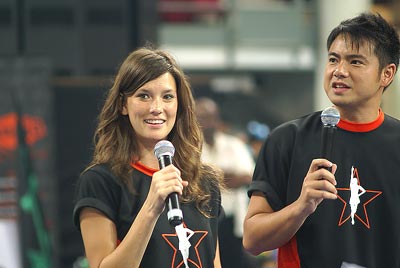
Sarah Tan and Jien, hosts that Sunday. And yes, this is a Minolta 70-210mm F4 beercan lens ad, where every picture except the first was shot with this lens.


Dynamitez won. They seem disappointed that their trophy looks like a cracked egg shell. Where are the shreds?


Wow, you want to do the teleporting maneuver on me? What an honor!


Beam me up Scotty!

I’m guessing he wished to teleport to the girls’ dressing room.


Because bam! The Titans came out of nowhere.


They also turned the world upside-down.


Magic tricks! The black banner quickly vanished down the middle into the white one. Clever.


And now, for the Dynamitez!


Explosive performance indeed. No exploding drummers, though.


Way after the show ended. “Over here la turn around stop perving up some other girl’s skirt shoot me woi!

Everybody was happy and cheery, I wanted to go up to a random girl and hug her and go “I can’t believe we got in the Top 3!” My bisexual friend, she… wanted to do so, too. 😀

I bumped into Goh Hao Wei there, with his Canon EOS 350D with battery grip, Canon EF-S 17-55mm F2.8 IS USM and Canon EF 70-200mm F4L (non-IS) USM. I wondered why he needed a battery grip when using the lightweight 70-200mm F4L USM, as my Sony A100 with Minolta 70-210mm F4 beercan lens was light enough to use in portrait mode without hesitation or strain.

It wasn’t until I held the camera’s grip and turned it sideways that I found out why. It was hard to grip sideways, as the grip was shallow! It was nothing to do with weight.

I could always quickly turn the Sony A100 anti-clockwise OR clockwise and it would not strain my arm. The clockwise turn is for a quick shot from above, grip nearest to you. The anti-clockwise turn lets you snipe something upwards in portrait orientation.

The Canon battery grip was far more substantial and let me do such stunts. 🙂

Oh, and of course, the Canon ultra-sonic motor was sweet. However, if you know how a SLR’s AF works you’d know how to avoid hunting. Oh, and its bokeh was creamy like my beercan.

Digital Back

I’m back!

Thanks all for checking, and for entering your email address to get an update when the site is back up. I know it’s usually something you’d skip out of laziness.

Geek Explanation, Skip If Not Geek

How did I take up too much bandwidth? It must’ve been when Google decided to link to my yearly archives, which have a lot of pictures. It decided to do so for its image search, too. Hence, anybody searching for something that might come to my site… would get my entire archive, ultimately killing my bandwidth.

Thus, I have disabled the yearly archive feature; you can only view archives by month, and to view pictures you’d have to click [Click here to show pictures.] in the top-right corner. Also, the archives are no longer dynamic, and are cached HTML files.

I have also made it mandatory to add 2 to 3 the first time you post a comment. This should help with those annoying spambots.

Some of the pictures are not up yet; they’re still being reuploaded.

The much, much worse news is, I accidentally overwrote the new database with an old backup… which wiped out all comments from 9th March 2007 onwards. 🙁 Thousand apologies for that!

DT on D7

And now, for shots from the Minolta Dynax 7, with the Sony 11-18mm F4.5-5.6 DT lens borrowed from smashpOp. All shots using the Dynax 7 with Fujifilm Superia 400 film, unless I have stated that it was shot with my Sony A100.


Dynax 7 with Peleng 8mm F3.5 circular fisheye, +1 compensation just in case, F16 1/15s.


Same lens, on the Sony A100, becomes close to a diagonal fisheye.


11mm F22 1/15s. The misaligned frame is due to operator error at the film scanner. Not me!


13mm F22 1/15s. This is as wide as I can go without vignetting. The lens does not have a marking for 13mm so it looks closest to 14mm.


11mm F11 1/40s ISO100 on the Sony A100, which has an equivalent field of view of a 16.5mm lens.


18mm F13 1/20s, still with the 11-18mm.


18mm F13 1/45s. This was using the Sony 18-70mm F3.5-5.6 kit lens instead.


22mm F13 1/45s. This is as wide as I can go without vignetting. The lens does not have a marking for 22mm so it looks closest to 24mm.


I then popped my Tamron 1.4x AF teleconverter and Minolta 50mm F1.4 lens on the Dynax 7, for what it reports as 75mm F2.0 at 1/500s. I turned to Smooth Transition Focus mode and attempted to camwhore. Even my steady hands could not brace for SEVEN CONSECUTIVE MIRROR SLAPS!

STF mode shoots 7 shots on the same frame, each with a change in aperture to produce a smooth, creamy out-of-focus area, similiar to the Minolta/Sony 135mm F2.8 T4.5 STF lens.

If the 1/500s shutter speed is to be believed, I must’ve shot 7 frames in 1/500s. 7 divided by 1/500s is 3500 frames per second. Eat that Canon EOS 1Ds Mark III!

Of course, it sounded more like a 7fps shot. I don’t know, I need to finish the current roll before I can do some proper testing to find out the maximum speed.


50mm F1.4, STF mode makes it 1/500s F4.5.


Using the Sony 11-18mm again, at 15mm 1/200s F8 in STF mode, manual focus to minimum focusing distance (25cm!)


15mm F4.5 1/90s. Now there’s vignetting! Alas, I should’ve stopped down because I was still far away from the mininum 1/15s required to get a steady picture at 15mm.

Yes, there’s no in-body stabilization on the Dynax 7.


STF mode on a moving subject! Sony 11-18mm at 18mm F9.5 1/20s. Something tells me this STF mode is going to be very, very fun.


A quick test of the Dynax 7’s Ratio 2:1 mode with my Sony HVL-F56AM flash. 11mm 1/60s F6.7.


This time around, 15mm 1/30s F22 and yet there was vignetting. I have no idea why.


11mm 1/20s F22. Again, misaligned frame due to bad scanner operator. Check out the flare!

The following shots were all shot with the Sony A100.


What about infrared performance? 11mm F4.5 ISO1600 3.2 seconds on the Sony A100 with a China-made 77mm infrared filter. There is a hotspot in the middle, sadly, marring its use for infrared photography. Stopping down usually brings out the hotspot… but it’s already there, wide open!


In comparison to the Sony 18-70mm F3.5-5.6 kit lens, 18mm F3.5 ISO1600 3.2 seconds. Then again, hotspots could be dependent on the object being shot. A proper tripod and bright sunlight could give more concrete results.


18mm F5.6 ISO400 1/60s on both the 11-18mm and kit lens. (Guess which is which.) Nope, the 11-18mm does not underexpose like some reviews claim; it is merely the camera having to face a wider scene with more bright and dark subjects. I used Aperture Priority to take both shots, and both metered at 1/60s. The A100 tends to save the highlights, especially so with backlit subjects. To counter this, I usually tap the AEL button on the subject to spotmeter on it.


Macro with the 11-18mm at 11mm F4.5 with flash.


Wide-angle jump with camera in hand!


Fisheye jump with camera in hand!

For a blast to the past, check out an interview about the then up-and-coming Konica Minolta Dynax 7 Digital. Yes, the CCD shifts over 1 centimeter!

My First Autofocus Film SLR!


Guess what I just got, sitting in between the Minolta X300 manual-focus film SLR (left) and Sony Alpha A100 digital SLR (right).


Squint no more, geeks! It’s the legendary Minolta Dynax 7.


Compared to the Sony A100, you can immediately see that it’s a button and knobfest. I know people who love it that way. I know I do.


The main dial controls exposure mode (where the center button must be pressed to unlock the dial); a dial below it controls drive mode, with options like multiple exposure and mirror lock up after 2 second self-timer; a knob controls metering, including an AEL (Auto Exposure Lock) button; a knob controls focus point selection, while the 9-point directional pad chooses the focus point, aligned perfectly on the rule of thirds.

In front of the shutter release button is one dial; behind the shutter release is a tiny LCD to show film frame count, and aperture. The dial behind can be used to dial in a custom exposure quickly.

Finally, one of the best buttons is the AF/MF toggle; when in AF mode, pressing it will switch to MF, while in MF you can press it to switch to AF. Beats changing the AF mode on the switch near the lens. 😀

Yes, this stroke of genius just arrived on the Canon EOS 1Ds Mark III!

Also, when AF mode is set to Automatic AF, and the lens is focused, the focusing motor screw will disengage from the lens to use Direct Manual Focus mode. You can then fine-tune focus without spoiling the focusing motor! Pentax has a similiar implementation called Quick-Shift Focus System to give their lenses something like full-time manual override focus.


On the left hand, there’s the exposure compensation dial, which goes from -2 to +2 in 1/3 stops, and -3 to +3 in 1/2 stops. This also needs the middle button to be pressed to turn. There is also a flash exposure compensation dial right below it.

For some reason, Minolta said that their On/Off switches should be on the left, and that decree carried on to the Konica Minolta digital SLRs and the Sony A100.

Frankly, it does not bother me. Have you found the switch on the Canon EOS 30D?

There is also a dial on the right of the camera to switch from red-eye reduction flash, normal flash, rear-sync flash and wireless flash (with adjustable 2:1 ratio).


Left: The data back. I LOVE THIS! It stores exposure data for the last 7 rolls shot with the camera. Scouring through, I could tell that the previous owner used the Minolta 28-80mm F3.5-5.6 lens and something at 150mm F5.6. He/she also used it with bright studio lighting, based on the smaller apertures (F11) and yet fast shutter speeds (1/500s). The last recorded date was somewhere in April 2003; after that, the camera time was reset to January 1st, 2000.

I can only wonder why he/she didn’t get the Minolta 24-105mm F3.5-4.5 lens instead. Budget, I guess. I got this and the 28-80mm at a second-hand pawn shop for RM399.

Right: The bitmapped screen is genius. Not only does it show your status and aperture/shutter settings in one go (like Konica Minolta SLRs, Sony A100, Olympus dSLRs, Panasonic L1, Nikon D40/D40x, Canon 400D), it can also be used to view the custom function text. Yup, no more cards and guessing what custom function number does what!

Personally, I never liked the idea of having a status LCD screen on top; when you switch to portrait orientation, you have to peek over the body to look for a tiny LCD that till today’s Nikon D80, still looks like a Game&Watch. The Dynax 7 reorients the screen when you turn it sideways!

…also, the LCD screen on the back has led many to think my Dynax 7 is a digital SLR. Heh.


Left: Miss the depth of field markers on your zoom lens? Worry no more, pressing the Depth Of Field preview button shows how much depth of field you get in front and behind the subject at your set aperture. This feature only works on Minolta/Sony D lenses, though, as it needs the distance information from the lens.

Right: The standard status LCD. Direct Manual Focus, Release Priority, single-shot drive mode, no exposure compensation, center AF point, multi-segment metering, 26th frame.

And now, for a rant.

I love Aperture Priority mode. I value having instant control over my depth of field. I honestly think that having your camera on Manual Exposure mode all the time is a very impractical thing to do, especially when racing to balance the exposure when you should be worrying about shutter speed or aperture alone.

If I need as fast a shutter speed or am shooting in dark places, I quickly flick the dial to choose the brightest aperture. If I’m capturing a sunny landscape or macro, I quickly flick the dial down to F16. If I’m shooting a sunny portrait and I wanna show your pores, I’ll flick to F8 to get more sharpness out of the lens. Backlit subject? Bump up the exposure compensation.

At no point should I have to worry about balancing shutter speed too. Frankly, people who roll two dials frantically look silly. Get with the program, yo.

And yes, it does annoy me when somebody picks up my Sony A100 and switches to Manual Exposure to take a shot that has no need for M mode. While it does show that the person has knowledge of aperture/shutter/ISO and its relationships, it is hardly practical nor smart.

I only ever use Manual Exposure mode when:
– shooting with flash to mix in just the right amount of ambient light while getting a deeper depth of field
– shooting out-of-Earth objects like the sun, moon and stars
– shooting in infrared
– shooting a gig where the lights fade in and out quickly, where clicking at the wrong moment will leave me waiting for a 4 second exposure to clear (though for this case, you should use Shutter Priority.)

End rant.


Pressing the AEL button, then pressing the Disp button, shows the camera’s metering of the 14 segments! (The 14th segment is the entire frame.) It shows which segment is over or underexposed (which is great for slide film shooters, who can quickly change compensation and have it recalculate the numbers on the fly.)

So why did I go out and get a Minolta film SLR?

I could use the Minolta 50mm F1.4 lens on a body it was meant to be used on, where 50mm is sweet. I could even walk around with the Minolta 70-210mm F4 beercan without having to step back much, being used to the Sony A100 with 50mm F1.4 giving a similiar telephoto feel.


Oh, and I could use the Peleng 8mm F3.5 circular fisheye on a full-frame body. 😀

The big ‘pro spec’ mirror on the Dynax 7 sometimes causes an error with the Peleng 8mm F3.5 fisheye attached; I’d have to unscrew the lens a bit (to get more distance), turn off and turn on the camera to resolve this. Strangely the Nikon D2X doesn’t hit it, while the Nikon D70 and FM does. (Source.)

This entry was posted in Geek, Pictures, Rants on by .

Click! Outside The Box

Have you ever woke up to a nightmare?

No, not wake up from a nightmare. Wake up to a nightmare.

I was supposed to be at KL Performing Arts Centre for the Sony Click! Ron Yue photography workshop at 10am, 19th May 2007. I set a few alarms on my Nokia N70 from 7:20am onwards.

That morning, I woke up without the help of an alarm, and looked at my phone. 7:23am, it said. Not bad, I thought to myself. I pressed the Stop button to disable the alarm that showed on screen. (It had stopped ringing.)

It didn’t stop.

I pressed every other button; it was not working.

I pressed the Power button. It would not turn off.

I opened the back, removed the battery, put it back in, turned it on and entered my PIN number.

It said 10:34am!

My phone had never froze on me before. I could drop it from waist level and it would be intact. It would only ever hang if I tried to play certain Symbian games. I would have to do something to get it to hang.

I rushed, grabbed a cab, and got there by 11:10am. I was too late to register for the Click! outdoor session (which was also a photo contest) and missed a big chunk of Ron Yue’s talk. He is one of the National Geographic freelance photographers.

Fortunately, some participants in the outdoor session went missing so I could enter. If not, I’d probably idle my time away in Ted Adnan’s flash workshop (which I had already gone for and won a prize while at it.)


We were to go around and shoot KLPAC, and submit 5 pictures of each category. All unedited, unlike this picture, of course.


I stuck my Peleng 8mm F3.5 fisheye inside an exhaust fan.


Hmmm, which wide-angle lens should I use?


Believe it or not, the fisheye did nothing to the curviness of the lake.


What The Duck?


The further away the object, the less distorted. Pointing it into a pond would give more distance and make it seem normal. Now, if only there was a netting on it, to show the combination of distorted and barely-distorted objects.


See the forest for the trees.


Oh, and of course, some mandatory geeking. I met a guy with the Minolta 85mm F1.4!

It didn’t have the same 3D pop and near-out-of-focus sharp rendition the Carl Zeiss 85mm F1.4 had. I would prefer the Carl Zeiss look, though this is good too.


I also saw the DiCain vertical grip. It looks a lot better in real life! A lot of people bemoan the fact that the Sony A100 does not have a vertical grip as an accessory. This is a third-party one. It does not come with the standard right-hand interface (knobs, buttons) but has a shutter button.

I wasn’t used to the shape though. Maybe I was holding it wrongly, but I felt it was mildly nudging into my hand. I put my Tamron 1.4x teleconverter, Minolta 70-210mm F4 beercan and Sony HVL-F56AM on for maximum load. It felt comfortable.

But really, a vertical grip is only used to:

– impress others with how big your camera looks
– add extra batteries
– support the weight of lenses more than 1 kilogram (the beercan and all Sony Carl Zeiss lenses are light in comparison)

I always carry two batteries with me so I don’t need a vertical grip.

The Sony A100 does feel heavy whenever the HVL-F56AM flash is attached, so I usually disconnect it and hold it up with my left hand like the Statue Of Liberty. This makes it very convenient to go from landscape to portrait orientation. Plus I can turn leftwards or rightwards without worrying about realigning the flash head to point up.

As for using the left hand, well… I zoom using my right-hand pinky finger. Fortunately, all Minolta and Sony lenses have the zoom ring nearer to the body. My kit lens is particularly light and easy to pinky-zoom.

In the rare occasion that I need to use my left hand, I just slide the flash back on its mount on the camera. The quick-release system Minolta invented works wonders!


It was probably the biggest gathering of Sony Alpha users! (And some Konica Minolta 5D users, too.) We quickly tried to flood Pentas 2 of KLPAC with our Sony HVL-F56AM wireless flashes! At one point I think there were six out.

I saw the same guy who bought the Tamron 17-50mm F2.8 A-mount at Pudu Plaza (that’s Alpha mount) at the workshop. He won something.

There was a dude with a huge bag with wheels, and in it, the old-school Minolta 28-135mm F3.5-4.5, with manual focus macro switch on the 28mm end of it. I saw 2 beercans. I saw the Minolta 50mm F1.7.

The Jam And The Junction

11th May 2007 – the first gig I went to in the month of May. Yes, that’s right. Classic Rock night at KL Jamasia. For some reason, I wanna call it The Jam.


Azmyl Yunor, folk/blues rocker meets my Peleng 8mm F3.5 fisheye. Sony HVL-F56AM wireless flash from right, held by Xian Jin.


Crosstown Traffic! Hard rock heavies. Flash from left, held by me, shot by Xian Jin. Never has accidentally putting the flash in a shot looked so good!


They didn’t do Lynyrd Skynyrd – Freebird. Damn you drunken rockers! At least they did Cream – White Room.


Reuben on guitar.


Shot by Xian Jin. As you can see, it is often a great, great challenge to illuminate a scene with a flashgun and a fisheye lens.


He asked if he could get my flash dirty. Sure, why not?

I didn’t expect him to take a few shots in the middle of the non-existent moshpit, getting a lot of attention at it. As it turns out, he was trying to get the shoe to glow by sticking the flash inside… and the rest of it was trying to kill the light coming from the camera’s flash (which must be up to trigger the flash.)

Technically, three things could be done to kill off the light:
1) Use the darkest aperture
2) Lower the ISO (it was 200, when the Sony A100 goes down to 80)
3) Put an infrared filter in front of the flash commander (it will still trigger, but I didn’t bring the filter)


Then, there was Triple6Poser. Hard rock and them foot-stompin’ blues.


Flash pointed left makes for some interesting balance between flash and stage lighting.


Zubira!


Scalloped frets never looked better on my soft-focus combo.


They did a cover of Pink Floyd – Shine On You Crazy Diamond, this time without a keyboardist. Oh and some Indon rock band, and Free – All Right Now!


Lohan! Jangan lari! You gotta sing with us!


N. Rama Lohan has a pimpin’ velvet case for his Gibson Les Paul. Damn.


The next night, I was at Groove Junction for Aseana Percussion Unit. This guy has amazing vocals! He can do a Louis Armstrong impression.


They played mostly adult comtemporary songs from a time gone by.


You will be a belly dancer!


I love my fisheye.


Leonard the soundman.


This is as close as you can get to having a teeth solo on percussion.


Gotta have more cowbell!


Something tells me she won’t mind carrying such front-heavy weights in the foreseeable future.

I’ll get my spaceship to pick her up.


Prema on vocals. That makes like, 3 vocalists or something.


I’ve posted this shot before. I love it!

Sightings


Just when I thought it was an uneventful neighborhood…


Strange sightings are seen.


Random streaks of light.


The energy arced and entered…


My neighbor’s car. It was alive! It glowed like the sun.

How did I do it?

It was a power outage. These shots were actually at 8 to 9pm, 20th March 2007. All shots at infinity, 30 seconds at ISO100, mounted on a tripod, and then darkened if necessary. Shots #1 and #4 were at 50mm F1.4, #3 and #5 at 18mm F3.5, shot #2 at 50mm F3.5.

Shot #2 was me with a torchlight. Interestingly, the moonlight was strong all the way till 10pm, when the power came back on. I had no idea moonlight was so bright!