Category Archives: Geek

Hot Beyond Red


What do you do when you see blistering hot skies?


You shoot infrared, of course! (This was with my Canon Powershot A520, circular polarizer, red filter, linear polarizer using this method.)


I turned it so that enough light would come in to expose the reds, to balance out infrared rays which appear purple. This was 0.5 seconds.


Slow-shutter stuff! 0.6 seconds.


0.5 seconds.


1/3rd of a second.

Anyway, the 52mm Hoya R72 infrared-pass filter had been adequate for my Canon Powershot A520. However, when fitted to the Sony A100, it was a different story – the exposure times were now in seconds, and it was predominantly red. What I did not realize then, was that the red is actually the little red that the R72 lets through!

The Hoya RM90 infrared-pass filter is a true infrared-pass filter; it blocks all natural light, letting only infrared through.

The Hoya R72 infrared-pass filter lets very little red in instead. However, on older point-and-shoot digicams the infrared-block filter was weaker, so in long exposures more of the infrared purple appears than the red.

The circular polarizer, combined with the linear polarizer, and turned so that it was darkest, was mostly black… but let in some violet!

The smarter of you might realize what I figured. 🙂


That’s right, combine the Hoya R72 filter with the two polarizers to kill off all natural light! The R72 took care of everything except red, while the two polarizers removed everything but violet (which is on the other end of the color spectrum from red.)

Note that the filters are screwed in reverse, because I did not have a 55-52mm step-down ring to fit the 52mm filters on my Sony 18-70mm F3.5-5.6 kit lens. 🙁 I used two UV filters, 55mm and 52mm, superglued to each other, instead.

The orange tape is there to show alignment; when the two tape markers are aligned, the polarizers do not let any light through (except a bit of violet.)

I then made my maiden voyage to Digicolor, Jalan Ipoh, where I discovered they had the same thing – a China-made, brandless infrared-pass filter! The price? RM55 for a 77mm true infrared-pass filter!

The 77mm Hoya RM90 infrared-pass filter would’ve been RM600 from some sources.

They also have 77mm warming circular polarizers for RM55 too! If I got any lens with anything larger than 55mm I’d get a set of 77mm filters. 😀

And so, I got Grace one, plus a 58-77mm step up ring for her Canon 18-55mm F3.5-5.6 kit lens. I got to take it for a test run. 🙂

Oh, and they have loads of step up and step down rings, all on a huge rack! Mount reverser rings (to put a lens front first on a SLR body) and reverser rings (to make two lenses face each other, to do super macro, albeit without superglue) all for under RM30! China-made madness!


From left to right, top to bottom: Sony A100 at 50mm F3.5 1/2s ISO1600 using Hoya RM90 equivalent; Sony A100 at 50mm F3.5 1/10s ISO1600 using Hoya R72; Sony A100 at 50mm F1.4 1/4000s ISO1600 using Hoya RM90 equivalent; Sony A100 at 50mm F11 1/320s ISO100 no filter; Sony A100 at 18mm F3.5 30s ISO400 using Hoya RM90 equivalent; Sony A100 at 18mm F9 1/80s ISO100 no filter; Canon Powershot A520 at 35mm equivalent F2.6 1s ISO200 using Hoya RM90 equivalent; Canon Powershot A520 at 35mm equivalent F2.6 1s ISO200 using Hoya R72.


Canon Powershot A520 at F2.6 1/10s ISO200 using Hoya R72.

The Hoya R72 is still very usable, especially on the Canon Powershot A520, where it can separate areas by the infrared intensity; purple for infrared and red for others.


Sony A100 at 50mm F4 1s ISO1600 using Hoya R72 and two polarizers.

I can get a similiar effect using the R72 and two polarizers on the Sony A100, if I dial in the right amount on the polarizers. Note the slight red tint in the skies!

So what about my infrared-modded Fujifilm Digital Q1?


35mm equivalent (this was taken with the webcam manual focus lens, before I put SLR lenses on the Q1) F3.5 1/2000s ISO100 using Hoya R72.


Same exposure, without filters this time. The blue gets to leak into the picture! In most cases the Q1 captures mostly infrared unless it is in a flourescent-lit room.

50’s Rage


The 50’s are in! From left, Olympus Zuiko 50mm F1.8; Canon 50mm F1.8 Mk II; Minolta 50mm F1.4 (pre RS), Fujinon 50mm F1.4 (without body).

I recently bought the Olympus from Mustaffa, a friendly guy who teaches black-and-white film processing! (Which is what every self-respecting B&W shooter does, pushing and pulling, dodging and burning, and having your own darkroom with funky chemicals.) Learning that would save a lot on film processing fees, so if you’re interested, email him at mustaffaaziz8@yahoo.com.

Sure, you could shoot black-and-white on digital but you don’t get the same contrast range.


From left: My Olympus OM-2000, Mustaffa’s Leica M6 TTL, his Olympus OM-2.

I finally got to touch a Leica rangefinder! Yes, it was way brighter than Kingsley’s Yashica Electro GSN 35, and the yellow secondary image was very obvious. Its film winder was a lot more refined and discreet, and he installed a soft shutter button.

The cloth shutter, of course, was very quiet.


The OM-2 was also an amazingly engineered camera, with fabric shutter, air cushion dampeners, and various springs to make its mirror so much softer than any other SLR. I couldn’t find the air tunnel they claim softens the sound.


My Olympus family. From left: Vivitar 2x teleconverter, Vivitar 24mm F2.0, Olympus Zuiko 50mm F1.8, Olympus Zuiko 35-70mm F3.5-4.8, Olympus Zuiko 70-210mm F4.5-5.6.


The Olympus Zuiko 50mm F1.8 is amazingly sharp! I think this was either F5.6 or F8. Click on the picture for a bigger view.


I love Fujifilm Superia film. This was the ASA200 version. Gotta love them emerald greens!


Using the 50mm F1.8.


24mm F2 (colors and lightness not adjusted. I love how the contrast is there, but doesn’t kill the shadows. Or maybe my OM-2000 overexposes just a bit.)


Near Burger King, Desa Sri Hartamas.


And now, guess what this is!


Below it, lies this. Yep, Jeff of Ampang Park had a broken Canon 50mm F1.8 Mark II lens lying around, and let me try my hand at fixing it. Note the 5-blade circular aperture.


The front element.


The front element, when reversed in front of another lens, gives awesome barrelling distortion and a closeup factor of about +20, I think. Shot at 35mm F36 ISO1600 with flash (to get enough focus to reach Jeff!) Yes, the Sony 18-70mm F3.5-5.6 lens was already at infinity.


Switching the lens to Manual Focus disengages the gears.


The front element, mounted on my infrared-modded Fujfilm Digital Q1.


20mm, F22, 1/60, ISO400 with flash.


18mm, F3.5, 1/10, ISO400. Focusing changes the strength of the effect.


45mm, F5.6, 1/15, ISO400.


50mm, F22, 1/80, ISO400 with flash.


This is goood sheeet.

Oh yeah after I was done playing with it, I just applied some force and popped it back on. It worked like magic and focused when I tried it on a Canon EOS 5 at Jeff’s the next day! I didn’t intend to disconnect it again though it had a cool effect. However, if you do permanently disconnect your Canon 50mm F1.8 Mark II, you know you could use the front element for some funky stuff. 😀

Eye Eye, Kept Turn


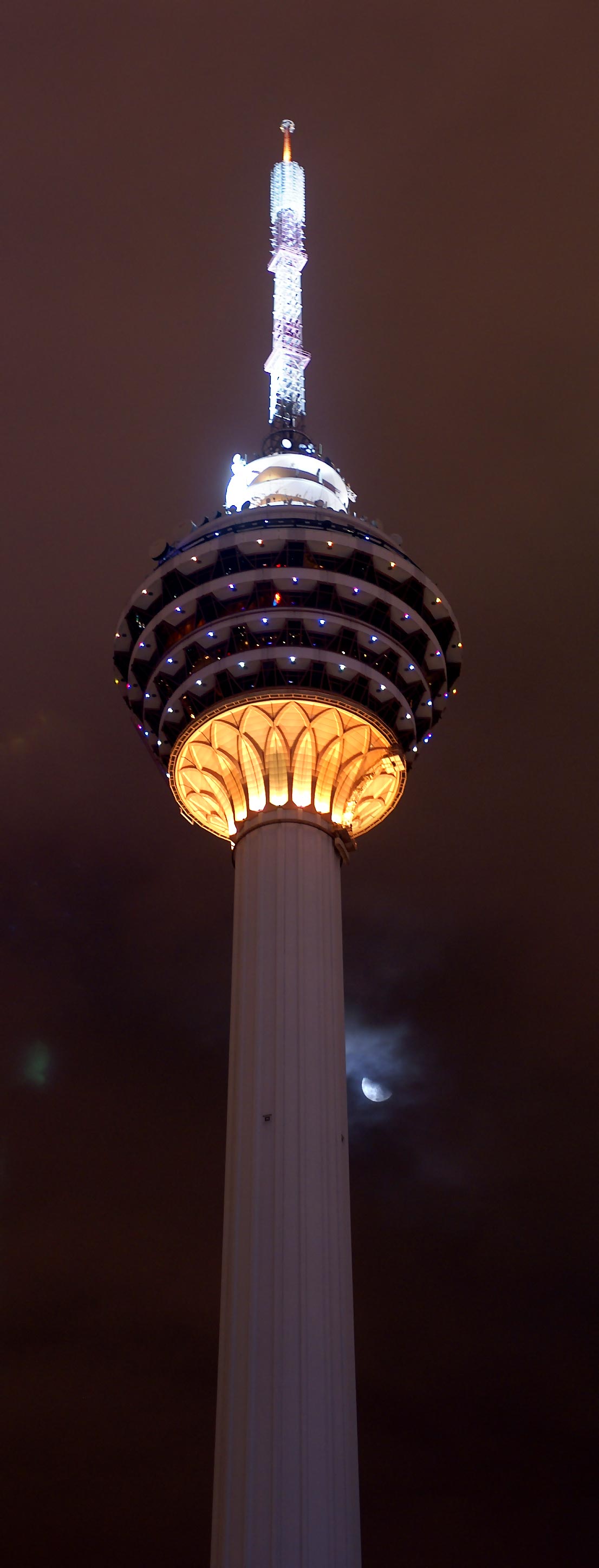
On the 28th of January 2007, I took a long walk from Titiwangsa Monorail station to the Eye On Malaysia!

Some photography enthusiasts did not want to go because they figured that everybody else had shot the EOM. Bollocks! If you are as enthusiastic, you’d inject your own style and make radically different pictures.

I went there with that mindset.

…and, for the first time, I brought my tripod out. 😀


2.5 second exposure, ISO100.


30 second exposure. Yeah, everybody has done this…


81 second exposure, on bulb mode. I held it down as long as I could; I’ve never held bulb mode this long before and don’t intend to find its limit. 😛


But first, smashpOp, Jenifur and Rames jump!

The bright spotlights inspired me to try this; Aperture Priority at F1.4 on my Minolta 50mm F1.4 gave me a bright 1/160 seconds. No flash was used! First time I’ve seen KLCC out-of-focus, even! Coincidentally, 1/160 is the Sony A100’s built-in flash sync speed.


Another, in front of the Eye On Malaysia. This was at 50mm, F1.4, 1/250th of a second.


And then, I zoomed. WHOA! Initially discovered this during an accidental pan shot.


I zoomed in and out on my Sony 18-70mm F3.5-5.6 kit lens while snapping away to get different permutations.


I thought I struck gold when I discovered the neon lights of the Eye On Malaysia had a refresh rate of 100 Hertz (blinking 100 times a second). Yes, I counted the number of flickers and divided it by the shutter speed.


And then whoa! Fireworks.


Out-of-focus fireworks remind me of Quake 2. Yes, the game I made a few models for.


I always wanted to zoom in on fireworks.


I also tried unsuccessfully to pan with fireworks. This looks like yarn though.


Initially a plain long exposure, the fireworks came on and I unlocked it from the tripod.


30 second exposure…


Though it depends when you hit the shutter (this, also 30 seconds.) Furry.

And now, for shots from my Olympus OM-2000.


Olympus 70-210mm F4.5-5.6 lens with Vivitar 2x teleconverter, giving 420mm F11.


Another 420mm shot, with boosted saturation.


Vivitar 24mm F2.0. I love how the shadows are so well exposed! Color/luminosity not tweaked. Took wideness of lens for granted, making Jenifur out-of-focus.

I love Fujifilm’s emerald-ish color! This was Fujifilm Superia ASA200.


Having two cameras, especially one that didn’t need dark frame subtraction (which explains the Busy sign after long exposures), was great.


True undestructive bulb mode!


Since I finally had a tripod near my house, I could do bulb mode on the traffic lights near my house! (No color/lightness tweaks.)


The virginal Sony version; got the green-yellow-red succession in 11 seconds hence the darker exposure.

If you bothered, you could count the seconds the lights are green, shoot 2 seconds before it turns yellow, and hold for 6 seconds (2 seconds for each color).

My first successful attempt was here.

Just as I was writing this, feeling all accomplished, I found out that TV Smith beat me to it! He is the man on the front of alternative photographic technique.

Glass I

Many things I have obtained, in the horrific financially-draining hobby of photography. This is part 2. (Click here for Part 1.)

Union 55mm +2 close up filter

I got this because it was cheap and lousy. Yes, I intentionally bought it for the chromatic aberration and softness it would give me.

A +2 close up filter changes your lens focus point from infinity to 50cm close. The math is 1000mm/diopter rating = focus point, so +1 = 1000/1 = 1000mm = 100cm; +2 = 50cm; +4 = 25cm; +10 = 10cm; +25 = 4cm.

Why would anyone buy a +2 instead of a +4?

So I could focus further away when the lens was on, and not have the insect I was shooting sense me so soon.

Hoya 55mm +4 close up filter

I got this as a more premium unit, at RM40. Stacked with the +2 it became effectively a +6.


When the +6 is used with my Minolta 50mm F1.4 (pre-RS) lens at F2.8, it enlarges the out-of-focus circles even more. The scratched texture you see is from a trashed 55mm UV filter, superglued to a 52mm UV filter ring. (My 50mm F1.4 had a 49mm filter thread size, with a 49-52mm step-up ring, so I had to use the superglued filters to reverse mount the close-up filters.)


At maximum out-of-focus-ness.


50mm at F6.3. This might give you a hint as to where this is.

Yes, close-up filters have the same effect whichever side you look through; it still has a positive enlargement.


Sony 18-70mm F3.5-5.6 lens at 70mm, F11, ISO100, 1/125 with flash on. Note the cheapo donut bokeh.


Minolta 70-210mm F4 beercan lens at 210mm, F32, ISO100, 1/125 with flash on, and +2 and +4 filters stacked on. I love the colorful distortion near the edges!


24/14mm = 1.71x magnification! Same exposure settings as previous picture.


At 210mm F4 with +6, the whites blur and bleed all over.


At 210mm F16, the effect is controlled and so much prettier.

Pro Tama 58mm close up/58mm 0.45x wide angle/fish eye set


From bottom to top: Minolta 50mm F1.4 lens, 49-52mm step-up ring, Hoya 52mm UV filter, 52-55mm step-up ring, 55-58mm step-up ring, Pro Tama 58mm macro, Pro Tama 58mm fisheye (which has a 67mm filter thread. Phew!)


The Octagon 55mm 0.45x wide angle converter, on my Vivitar 24mm F2.0 lens on my Olympus OM-2000 film SLR.

I got this instead of the Octagon 55mm 0.45x wide angle converter (also sold at Ampang Park) because:

The Pro Tama set was made of two components; the close up filter (I estimate +13) and the fisheye. When the fisheye is screwed in front of the closeup, it becomes a wide angle converter! The fisheye had a 67mm screw filter thread on the outside, while the Octagon did not.

The cons of the Pro Tama were that it was 58mm (meaning I had to get a 55-58mm step up ring, and adding space between lens and converter, causing stronger vignetting than the Octagon). The Octagon, when reversed, had awesome funky lateral chromatic aberration. You have to look through it to appreciate it; it stretches everything not in the center like you were entering warp speeds, and the whites bleed all sorts of pretty primary colors (as opposed to traditional CA, which just looks icky purple.)

The Pro Tama just stretches the sides but does not cause funky colors. 🙁

The close up filter is amazing; I can get 1:1 lifesize magnification when screwed on the 18-70mm at 70mm!


The Octagon, reversed, features awesome funky lateral chromatic aberration. The Pro Tama has the warping effect, without the funky colors. 🙁

The warping effect can be shifted, by tilting and shifting the reversed Pro Tama. Much like a Lens Baby!


Both converters had vignetting at 18mm. The simple reason being that they were designed for lenses that start at a measly 35mm; thus, it could widen that to a 35mm * 0.45 = 15.75mm, or 35mm * 0.7 = 24.5mm. The imaging circles at the back of the converters are not big enough for wider lenses.

I needed to zoom to 22mm at least, on my Sony 18-70mm F3.5-5.6 kit lens, to avoid vignetting. By then, with digital crop, it had already become 33mm… multiplied by 0.45 to get 14.85mm. Of course, I loved the vignetting and minor light falloff, so I used it wide and got 18mm * 0.45 = 8.1mm. Add the digital crop to get 12.15mm.

On the Olympus OM-2000 with Vivitar 24mm F2.0 lens things were more promising; there was still vignetting but 24mm * 0.45 = 10.8mm wide!

(I can’t show you shots from the Olympus because I haven’t finished my first ever roll of Fujifilm Velvia 100F.)

Through more usage, I had the sinking feeling that the wideangle converter was not really 0.45x; in application it was like a 0.7-0.8x. I haven’t figured out how to properly calculate it though, but the answer to the question is, “Yes, it is wide enough.

What if it was just the fisheye, since I could omit the 58mm macro element?


It becomes a close-up with fisheye barrel distortion! I had to shoot at F22 with flash to reduce out-of-focus-ness, even at infinity.


I also tried the Sony 11-18mm F4.5-5.6 DT lens. It was, well, disappointingly straight. (Though, that’s what people pay for.) I tried to coax some barrelling but none was obvious. This certainly wasn’t an artsy lens; the Sony 16mm F2.8 diagonal fisheye would have served that purpose.


I can’t tell if there is distortion, other than the stretching of faces towards the edges of the frame.

At 11mm, it was probably the sweetest at F5.6-F8. There was slight softness at my only 1/3rd of a second shot, and crispness at 1/6th. I attribute this decreased steadiness to me not holding it confidently like it was my own to sweat all over the rubber grip. Y’know how it is, once you’ve got the feel and grip of things your steadiness increases… so if I could get it to my 3.5-stop average I should get 0.8 seconds steady.

I have this nagging feeling that in-body stabilization really works better on the tele end, contrary to popularly propagated claims.

The camera knows the focal length from the lens, and it adjusts its corrections according to which lens is used. Real-world tests have confirmed that these in-body systems are just as effective as in-lens systems, even with longer lenses.

From a most informative Minolta AF/Sony Alpha F.A.Q., which is a great read even if you don’t have a Minolta/Sony SLR (especially the bit about focusing beyond infinity.)

Random Tip #1

My Sony 18-70mm F3.5-5.6 kit lens focuses slightly beyond infinity. However, all I need to do to set it to infinity is to turn the camera off and on! (The camera sets the lens to infinity even in manual focus.)

Random Tip #2


Default settings.

I lower the contrast to -2 and boost the sharpness to +2 by default on the Sony A100. You can always add contrast in Photoshop easily, and the +2 sharpness doesn’t seem to affect noise.


What I prefer.

The Sony A100 very predictably underexposes when there is backlight and is set to Multi-segment Metering, with Dynamic Range Optimizer Advanced on. It’s great that it’s predictable, so I can quickly bump the EV to +1 (with DRO+ keeping the highlights in check.)

And so, for a flatter but colorful backlit scene, I’d suggest setting contrast to -2, sharpness +2, saturation +1, EV +1.


Setting the contrast to +2 on the other hand, gives this.


I then pumped the EV to +2 to bring out the purple fringing in the trees.


I stacked my Hoya R72 52mm infrared-pass filter, and my Raydawn 52mm circular polarizer and linear polarizer, then the Pro Tama, to get this severely vignetted infrared shot. Quite cool, the internal reflection of flare.


I loved the gradual light falloff. The vignetting adds character to the picture, and I have to say I’ve never felt so inspired. Lines that extend from the center are least likely to be distorted.


At effectively 12.15mm I could afford to shoot at 0.8 seconds! (This was at F3.5 1/5s though.)

I paid under RM150 for the Pro Tama. Awesome deal, and a great way to stretch your creativity on just a kit lens alone! You get true life-size macro, a pseudo-fisheye, and a reverse-handheld tilt-shift lens!

Clearing Time!

Ferns Album Launch, 2nd of February 2007, at KL Jamasia. Finally, I’m updating within the same month!


Keng of Furniture, shredding the blues for folk-rocker Azmyl Yunor. Shanon Shah was on keyboards!


Azmyl, ganas wei.


One half of Couple, lo-fi indie pop darlings. Quite a massive following.


…even if Hana wasn’t playing with them. Eh?


Happy music!


Warren Chan of Ferns, dreamy indie pop of the softer, frail variety.


Abigail blows the… uh… keyboard.


Adlin gets a KLue (speaking of which, where the heck is this month’s issue?) and sits down.

Fast forward to 8th February 2007, Moonshine, A Homemade Music Show.

The first thing people would notice about Laundry Bar is how the stage had shifted.

The second is that the comfy Laundry Bar plushies have disappeared.

The third would be the carpets, left to hang dry on the walls.

The first and third help to make the sound better, by reducing sound reflections. Okay, maybe it was for Chinese New Year too. 😀


The sound engineer gets a more glamorous deck.


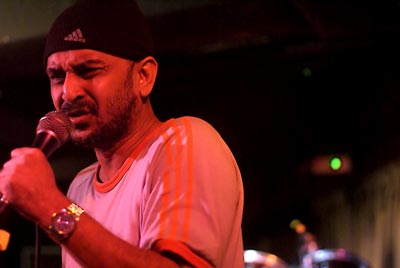
Melina (who I shall no longer identify by her main band because she has become a band slut) performing with…


Reza Salleh, sexy alternative/modern/grunge/R&B rocker.


Guess which band Rahul (only of One Buck Short, heh) is playing for!


I let my friends play with my camera, and they set the white balance for me. I went up and took this shot with flash. Gee, thanks! (Your standard uninnovative photographer-wannabe would say, “Next time, shoot in RAW, stupid!“)

Aye, but he/she is forgetting the days of point-and-shoot and intensive Photoshop post-processing (and how proud he/she was of it.)


Don’t be lazy, even Levels can fix it. I went further and made it look like a cheap digicam. Anyway, that’s Alex Ang, yet another band slut. Guessed which band this is yet? (There’s also Zaim of Curtis Blues Review on bass.)


Ash Nair! Best known for his stint in Malaysian Idol and as one of those CLEO Bachelors.

I might’ve just discovered an interesting effect; using the wrong white balance with controlled flash power to isolate subjects.


I’m not sure if I’ve seen him before.

And now, for a rant.


An out-of-focus picture of Kimberly and Tan Yee Hou‘s friend, shot at 50mm F2.0. Shot by a friend who I won’t identify.

And this is why the Nikon D40 sucks. (No, this was taken with my Sony A100 with Minolta 50mm F1.4 lens… in manual focus.)

The D40 cannot use auto-focus on Nikkor lenses that do not have motors inside them. Thus, you’d need to get an AF-S or AF-I lens. However, Nikon does not make AF-S versions of their bright primes (at least F1.8), like the popular Nikkor 50mm F1.8D lens! (And when they do announce it, it takes ages to arrive and goes out of stock.)

Ironically, a bright prime which has narrow depth of field needs auto-focus the most.


Tan Yee Hou. Shot at 50mm F2.0, which is enough for someone sitting at the same table to be reasonably in focus. Identity of shooter withheld.

I’ve discovered is that most people can’t do manual focus, even in restaurant lighting! (Or haven’t a clue how to see if something is critically in focus.)

Yes, I’ve been asking people to try to manual focus, doing random samplings. (I didn’t ask them to half-press and spot the focus-assist dot, though… that would tell them if it’s in focus, which defeats the purpose of the experiment.)

There was once I met Fazri and his friend, Brian, and I asked him to manual focus and he got a sharp, in-focus shot.

Later in conversation, I found out that his father had an Olympus OM-2. Yep, one of those legendary, very quiet fabric-shutter manual exposure manual focus film SLRs. Manual focusing must be in his blood!

(Okay, so later he whipped out a digital SLR, so he already knew what in focus looked like.)

Imagine, there could be a generation of budget-strapped people getting D40 units with the cheapest first-hand Nikkor lens, the 50mm F1.8D, and taking loads of out-of-focus shots… and not knowing it.

A D40 could be retrofitted with a manual focusing screen, but because of the matte area, metering would be screwed, overexposing out-of-focus areas. Teehee.


Xian Jin nails the focus on this shot of Matthew. This was on the 50mm at F1.4! F1.4 is much more challenging, but done correctly, the right parts of the picture are in focus, with the bonus of soft focus in the other areas.

In general, with a small depth-of-field, one should focus one-thirds into the subject. For a face, the eyes are most critical; focus that and the nose and ears will be reasonably in focus.

Lie Surgical Seed Die At Her Might

27th January 2007: Bear With Me (I only got to Jamasia near midnight, after Bryan‘s birthday celebration.)


Lightcraft, indie rock darlings.


Ooo hot chick photographer!


Ask Me Again.


Kick. Ass. Emo core.


The annoying lights, which kept fading in and out, led to me metering when it was dark (and thus overexposing) or metering when bright (and thus underexposing). However, I quickly discovered that the lights could create such… double exposures.


They Will Kill Us All, post rock.


I loved it when they kicked in the strobe lights! (This is definitely new for Jamasia.) I panned the members and got this interesting transition at 1/2th of a second.


1/6th of a second, for fewer strobe images and more discreteness.


What about zooming?


Yeah, to some extent.


Scream your post-rock spirits out!


Faux cross-processing on the members of Triple 6 Poser.

Muse, Bah!


26th January 2007, Muse Bar, The Weld, Kuala Lumpur. An upcoming place for live performances.


Ziel!


I tried to capture the flare and ghosting, inspired by Ahmad Saiful‘s Olympus E500 flare-ful shots. Open wide, F1.4!


I don’t usually like to capture performers looking at me as if I was doing street photography, but some people think it works, so I offer this version.


Dragon Red! With a twist…


Slyde was missing, and Adam had to rap…


Manshaan was still on drums for one of the most explosive acts in the scene.


Filler bassist!


No turntablist either. Everybody was busy. But it made for an interesting set, including covers of The Cure – Love Song.


Surprise, Amil raps and sings!


Guest screamer.


Another surprise – Adam plays bass (and looks like a cross between Melina of Tempered Mental and Aru of Koffin Kanser.)

Both Adam and Amil kept time, and didn’t miss notes or words. Awesome. The Dragon Red Trio looks like it could work.


Open mike – Raffique plays more.


Raffique and Aishah.


Where is she?


Aishah and hot drunken chick Diana (who has a deejay sister who tells laaame jokes on stage; anyone who has seen her emcee for Jamasia gigs will know.)


Alex Wong of Singletrackmind, owner of the place (left) singing his English version of Peterpan – Mungkin Nanti with Manbai, the soundman.


Yes, the guy who sang Ilhamku. He’s hilarious on stage. He also sang a powerful version of Search – Fantasia Bulan Madu.

I’d show you videos, but there are a few reasons why I don’t:

– my video recordings are not steady, especially since I try to shoot pictures with my other hand
– you can hear my camera clicking away
– okay, so really, when it’s a song I want to record, the uh… enthusiastic crowd sings along, spoiling the video.
– okay, so really, my voice is nearest. Not only do you hear my funky-orange-juice-influenced singing, you get to hear my wrong lyrics.


Click on image for larger view. I managed to snap this at 50mm F2.2 ISO100 and 1/2th of a second. Yes, a half of a second! That’s over 5 stops (and this was standing up without resting on anything, with the funky-orange-juice in effect!) Okay, so pointing up always increases stability.


Click on the image for the original 1.5MB file, uncompressed with EXIF data for all to see. The thumbnail is a 100% crop, this time at 50mm F1.4 ISO400 and 1/2th of a second. I usually don’t get such sharp pictures at F1.4 (though being at infinity there might be some exceptions.) Contrast was lowered in camera because I like it that way and makes for more fun post-processing.

Audio Visual Text

What: Moonshine KL
Who: Zach Tay Trio, Ash Nair (Malaysian Idol), Neomedicus, Reza Salleh
When: 9:30pm, Thursday, 8th February 2007
Where: Laundry Bar, The Curve
How Much: Free entry

More details here.

What: Indie-Licious
Who: Sky Juice Coffee, IG Collective, Telephony Delivery, Project Ei8ht, Crosstown Traffic, PG 165, Edward Gomez
When: 8pm, Saturday, 10th February 2007
Where: KL Jamasia, Desa Sri Hartamas
How Much: RM15 entry

For more information call: 012-7697749 or visit http://www.kljamasia.com.

What: Hearts N Lightbulbs Valentine Event
Who: Jerral Khor & Zalila Lee, Nick Davis, Diplomats Of Drums, Saer Ze, Wong Yu-Ri, Soft Touch, Estrella, Reza Salleh
When: 8pm, Sunday, 11th February 2007
Where: (venue changed) Laundry Bar, The Curve
How Much: Free admission (but this is a charity show, so please donate!)

The event is organized by Feathered Friends Network. Proceeds will go to St. Jerome Home, a home to 18 children aged 2-16 years, taken care by Brother Peter. They urgently need a washing machine and funds for the children’s school fees.

Yes yes I’m going for all three.

And now, for camera geeking time. Fun reads:

Edwin’s CameraHobby.com

This guy writes lushly in his reviews; you’ll never feel like skimming through because he goes into a historic review of things before getting to the product at hand. Truly an experience for the camera geeks. God knows how many did-you-knows I picked up, like:

USM was pooh-poohed until Nikon came out with their own version called AF-S and suddenly it became the best thing since sliced bread to be able to override the lens focusing without switching levers or buttons.” – Nikon AF-S VR 70-200mm f2.8 G IF-ED review

Yes, it all sounds too familiar.

As far as I know (but am likely wrong) the predecessor A1 was the first digicam to offer IS built into a digicam chassis. While the traditional IS/VR developed by Canon and Nikon is built into the lens, the A1/A2 went about it a different way and incorporated it into the body, a seemingly good idea for this class of camera and one that is going to be taken to the next step when KonicaMinolta produces their first D-SLR. Pop Photo magazine indicated that KonicaMinolta went this in-camera IS route to avoid the patents that Canon and Nikon have for in-lens IS/VR mechanisms.” – KonicaMinolta A2 review

Oh. I guess Panasonic found a loophole when implementing lens-based Mega Optical Image Stabilizer.

Still, CCD-shift works for me, and as they say YMMV (Your Mileage May Vary), and I’m getting a heck lot of mileage.

Petteri’s Pontifications also provides a historical ride down camera history.

The Minolta 7000 changed all that. Here was a camera that could undeniably focus and track faster and more consistently and precisely than even the most practiced manual-focus SLR shooter. It took the camera market by storm, and for a space Minolta looked set to take the top spot in the professional market as well. It was clear that Nikon, Canon, and Pentax had to do something — or go the way of Olympus and give up on the SLR market.” – Ugly Ducklings: The Early EF Primes

It’s also great fun reading his lens reviews; he nicknames all his lenses.

I think I’ll nickname my lenses too – the Nocturnal, the Beercan, the Kit Kid, the Loupe, the Orphan, the White Bride, the Sharpie, the Zoom Zoom and the Onanist.

…or maybe not.

More old-timer goodness can be found at The Online Photographer, (formerly known as 37th Frame) with a few contributors, all of different uh… allegiances.

Photography In Malaysia is always a fun read. The Minolta Maxxum/Dynax 7000 article is quite interesting. Initially, there were only twelve auto-focus lenses available, (of which I have the Beercan and 50mm F1.4) but none of them were lousy or dark, at most ending at F4.5!

Yeah so why am I quoting all these sites? It might be my inclination to think of my Sony A100 as being the descendant of what was then groundbreaking Minolta.

Random Thoughts:

If there is CCD-shift anti-dust, and CCD-shift image stabilizer, why not have CCD-shift autofocus ala the Contax auto-focus SLR, which moved the film plane? (Obvious weaknesses would be that shake could make an out-of-focus picture, and that the CCD cannot move enough to be sufficiently macro. However, if the lens was at closest focusing distance, moving the CCD back would provide significantly closer focusing distances!)

Another question would be of digital SLRs in film SLR bodies, e.g. the Fujifilm S3 Pro, based on the Nikon F80 full-frame film SLR body. Do they have full-sized mirrors? Does that mean you view a full frame, but with the digital crop? (Quite like a rangefinder, letting you spot action outside the frame. Coolness.)

Why didn’t Konica Minolta (and then Sony) reuse the Konica 58-400mm F4 Hexanon AR or 35-100mm f2.8 Hexanon Varifocal AR?

Return In Black And White

Wise man once said, “When you want to shoot in black-and-white, buy black-and-white film.

Okay, so the wise man was me.

Okay, so I didn’t buy the black-and-white film; Kingsley gave me an expired roll of 24-frame Kodak T-Max Pro ISO 400 for my birthday.

In any other case, I usually shoot in color, and then use the Hue/Saturation/Lightness tool in Photoshop if I want to change it to black-and-white, as it gives me 6 different channels of color to make black-and-white from. Picking black-and-white on your digicam or digital SLR is simply not the same.


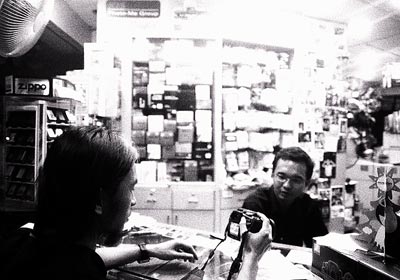
Location: Jeff’s shop at Ampang Park, featuring me showing Jeff my Sony A100. I think this was the Vivitar 24mm F2.0 lens on my Olympus OM-2000. Asyraf shot this. This is the shop where I usually get my film processed and scanned straight to CD for RM10 a roll.


Honestly, I didn’t find the dynamic range of black-and-white negatives that amazing. The grain was also so much stronger than equivalent color negatives (but immediately removeable with Photoshop’s Despeckle filter, which is so much more effective on film grain than digital noise.)


And so, I used a 52mm UV filter superglued to a 55mm UV filter to attach my Hoya 25A red filter to my Vivitar 24mm F2.0 lens. There was awesome vignetting because it was a wide angle lens, which less allowance for smaller filters. The red filter reduces light coming through, around 1-2 stops. In this case it also increased the exposure for the trees, in an almost infrared-like way.


However, putting the red filter was so much better than without! Red filters increase contrast and darken blue skies. Also, with a red filter, you really feel like you’re seeing in black-and-white.


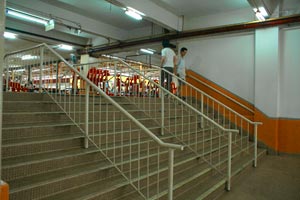
Bukit Jalil stadium, from the LRT station.


That is all. Black-and-white, used in the correct situations, will look great. Also, it is much more possible to do your own black-and-white film processing than with color. More on that later.

In other news, Syaz won 2007’s first Guess That Trashcan instalment, guessing Subang Parade’s new carpeted floor as the location of the trashcan. I can’t pimp him/her because I don’t know him/her and don’t have a URL to work with. 😛

Don’t Know All 69

Big Blogger Meets are where bloggers meet up to sit and discuss worldly topics, and ways to solve problems that plague humankind.

However, when the conversation dulls, we take pictures!


Amanda and I. Spot the commotion in the background!


(Insert conversation between Rames, Joshua Foong, Su Ann/Pinkpau and Asyraf Lee.)


The other Jen, a green snake.


Introduction session involved people throwing the duck at other people. The victim would then come up and introduce him/herself.


Claire Khoo presenting the prize to Erin. I must thank my cheapo UV filter for providing the ghostly effect.


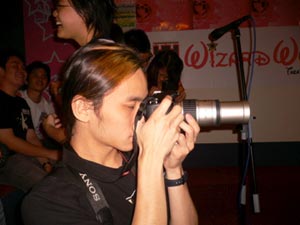
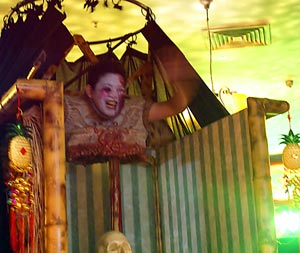
A blur (but adorable) Su Ann/MiszMilk about to enter Wizard Cafe‘s haunted house.

We had to wear 3D goggles of the red/green variety, which made the painted glow-in-the-dark marks on the walls appear to float. As the Daring Dude In Front it was my task to point out curtains where ghosts could possibly jump out and attack you.

A benefit of being that dude was that most ghosts did not attack me. 🙁

The end of the haunted house was awesome, dizzying shit. Ingenious.


I stole this picture from Boss Stewie. I stole this Pentax K100D with 100-300mm lens from Dylan. And yes, Pentax’s CCD-shift Shake Reduction works like a charm, getting a sharp image at 1/30th of a second at 300mm. 4 stops!


Random shot of the crowd at such low resolution to hide whichever aged blogger wants to conceal his or her identity (Christine will you please own up?)


…and another.


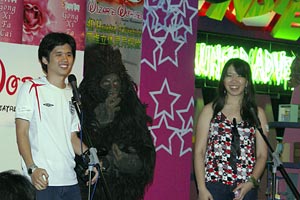
It’s also said that Frostier and Wingz were there. For all we know one of them was in an ape suit next to organizers Tan Yee Hou and Jolene Lai.


Penny Chow and I. So pretty. Wow my right chest was so lucky to be graced more by this hot chick’s presence!


Su Ann/pinkpau and Albert Ng doing a Johnny Depp doing a pirate impression (okay I wasn’t feeling piratey because I just shaved).


Pat and Mikel from the East Side, yo. For some reason I think both of them look like Nickelodeon characters.


Su Ann/pinkpau and duck. So cute, sooo pinchable (though probably not in public.) Just turned legal yay!


Wai Fon, Nazrul and Su Ann/pinkpau.


Wai Fon: You know what? I need to get laid.
Nazrul: Oh sorry, I wasn’t talking to you, I was talking to your boobs.
Su Ann/pinkpau: Anybody likes paus? Pink paus?

I like paus, but I don’t like pink. That is a problem.


Penny Wong says it’s emoticon time! Spot the Josh Lim.


Another low-resolution crowd shot.


Cheryl and I. I look like I’m molesting a wax statue.


Stone versus wax.


Eve and I. Cute!


From left to right, back row: Calvin Tay, Rames, Cherrie, Jenifur, smashpOp, Eugene (I’m sorry, I don’t remember your memorable URL. Sins deeds something argh.)
From left to right, front row: Kel Li, Natalie, Slinky, Bryan Chin, not-such-a-wax-statue-eh Cheryl.


Su Ann/MiszMilk, the other Jen and big-headed me.


Slinky the lounge singer.


I wonder how much he got paid to have his lower body ripped off in addition to having to wave at people all day.


As Xian Jin and I took the stairs down, we discovered that the hidden cafeteria in Sungei Wang was still alive! I thought it was taken over and demolished once the 6th floor was built. That, and the open car park were still there!

And now, for some camera geeking.


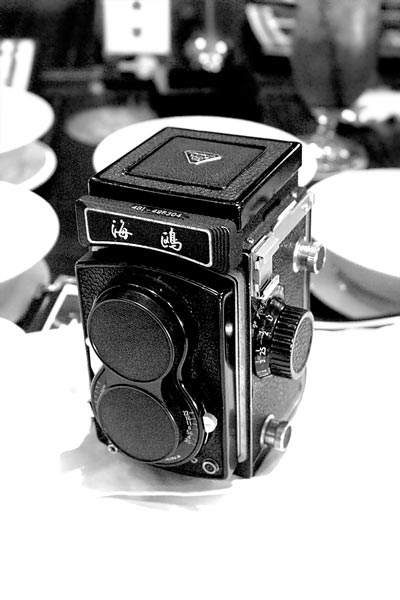
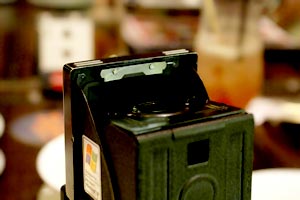
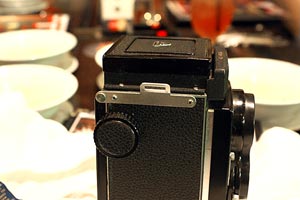
Yee Hou finally brought his Seagull SA84 Twin Lens Reflex medium format camera. He loaded the 75mm F3.5 China-made beauty with 60x45mm 120 film. The shutter release was at the bottom-left side of the front plate, with aperture and shutter speed dials on the sides of the film lens. (The film lens is the lower one; the upper one is just for focusing, which means no mirror blackout or mirror slap.)


With eyepiece magnifier popped up.


The film advance crank was on the right side. The focus crank was on the left side (not pictured) which drives both lenses nearer/further from the film plane. I used to think that focusing was by turning one lens (where the other lens would turn the opposite direction.)


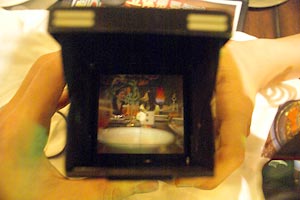
This is what you see. An almost holographic 3D-like projection!

More pictures and blog entries are at Tan Yee Hou‘s blog.