Category Archives: Geek

Last Gig Of 2007!

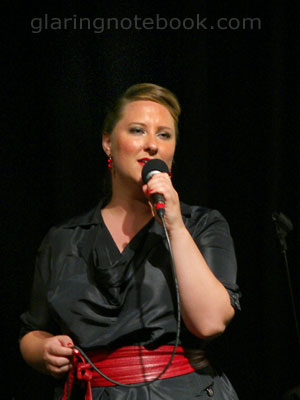
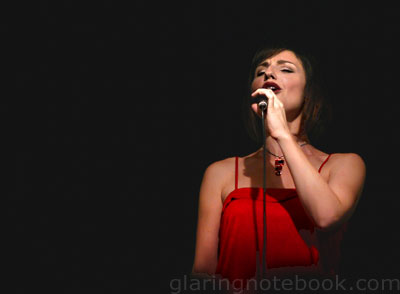
It was the No Black Tie Acoustic Countdown one 30th of December 2007.


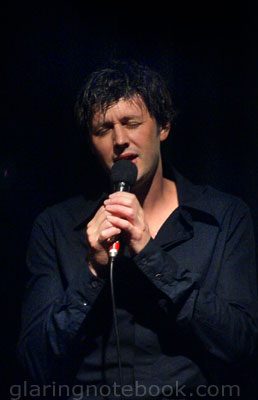
Otam, who we all think sounds black.


We kid you not the kid has the blues the folk and the gravel-y voice to pull it through. Plus some catchy melodies.


Azmyl Yunor! Good ol’ folk singer with a touch of humor.


Mia Palencia! This lady got a lot of soul.


Paolo Delfino Gomez! Jason Mraz/John Mayer styled songs about the opposite gender. Of course, he doesn’t take upon it too seriously, with some of the funniest lyrics sang that night.


Reza Salleh! Emotional, heartfelt ballads with lush compositions, and modern rock numbers. *


Pete Teo is almost the Man In White. Folk, with a touch of something else. *


Raffique Rashid, yay! Always the one with the funniest stories told in lyrics. He had the most booming, classic, dramatic, macho voice of them all. I don’t quite know how to describe it. *


Shelley Leong! Jazz-tinged musings of life. *


…and, of course, the violent guitar slapper and tapper, Az Samad.


This is the double-tap…


…and another, in double time!

Technical details:

All shots used the Sony Alpha 700 with the Minolta 70-210mm F4 “beercan” lens shot wide open at F4. Yes it’s scorchingly sharp. All shots at ISO1600, except the second animation which mixes two sequences of ISO3200 and ISO6400. Finally, the last animation was entirely in ISO6400.

* pictures marked with an asterisk might’ve been taken by Waifon or Patrick. I’m not sure exactly which but that means my style can rub off on other people wow!
They Came From Down South

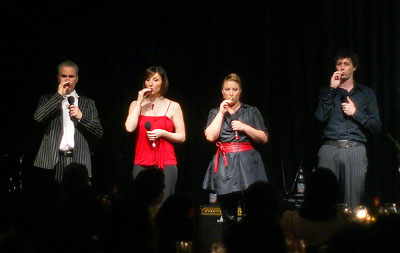
Rewind to The Idea Of North, Alexis Bistro, Great Eastern Mall, some 28th of November 2007.


Nicholas Begbie on tenor. The young awkward dude.


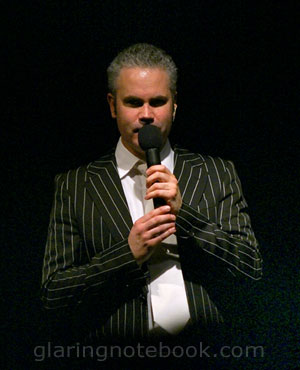
Andrew Piper on bass! He looks a bit like Will Ferrell.


Patricia Delaney-Brown on soprano.


Naomi Crellin on alto.


This German vocal-effect-ful song, My Hat It Has Three Corners, was cute!

Some of the songs performed were Sergio Mendez – Mas Que Nada (yeah the song that Will.i.am bastardized with the Black Eyed Peas), The Beatles – Sister Sadie, Sting – Fields Of Gold and Bee Gees – Stayin’ Alive. There were also jazz standards which I never knew the names of.


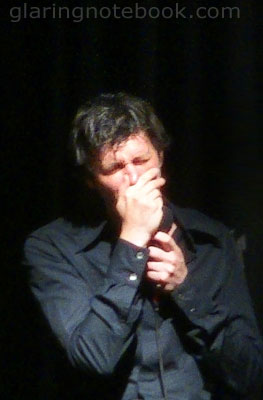
Then there was Stevie Wonder – Isn’t She Lovely (with an excellent vocal harmonica solo by Nick.)

Though, to be honest, I wasn’t completely blown away until they did the vocal effect bits. There’d be nothing to set them aside from a top-notch acapella group that does contemporary covers. In that sense, maybe I like unconventional acapella, like simulating the sound of a car starting or rockapella. It gets far more interesting when they simulate the sound of drum rolls!

That said, maybe it takes a finer ear than my rock-corroded receptors to appreciate how they pull off the simpler-sounding, less flashy stuff.

On a technical note, I shot all of these from a table next to the entrance of Alexis. Yes, that’s right, all the way at the end. Thanks Nicholas for letting us crash your table! Shot with either the Minolta 50mm F1.4 or Minolta 70-210mm F4 beercan at ISO1600 or ISO3200 on the Sony Alpha 700 and cropped a lot to show you how much I can get out of a ISO3200 shot. Interestingly, the noise reduction at higher ISOs on the Sony is luminance noise reduction, not chroma noise reduction like on the Nikons. Debateably the Nikon may look better at 100% because it has monochromatic noise and doesn’t have blotches of color… but the Sony retains color fidelity and tone even at ISO6400.

To simulate chroma noise reduction, load a noisy image in Photoshop, duplicate the layer, apply a Gaussian Blur of say 3 pixels, then change the Blending Mode to Color and Flatten Image. Notice that the edges lose color and you get a pastier look.

More on this here:
Alpha 700 shoots the Cirque du Soleil

I Ex 9xi


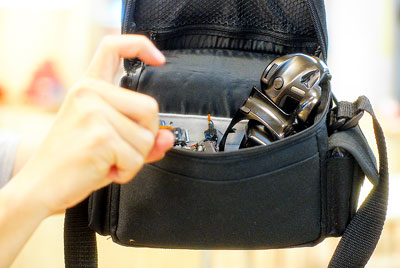
Some mamak in town, I met up with some A-mount hackers. This is the coolest sling bag I’ve seen, which would fit my style if I liked having a camera on my back.


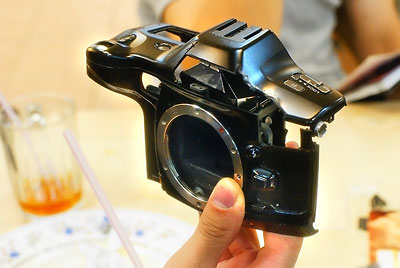
A deceased Minolta 9xi, the world’s fastest autofocus SLR back in 1992. God bless its soul.


The pentaprism.


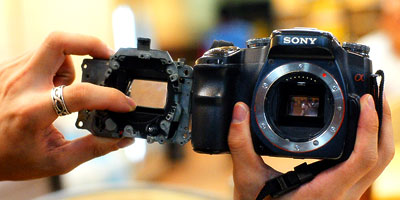
Full-frame mirror assembly next to an APS-C sized mirror on the Sony Alpha 100.


Viewfinder and the LED display below.


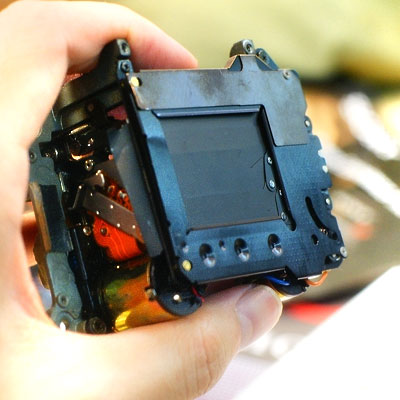
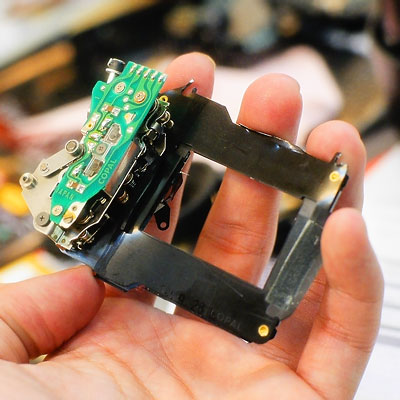
The shutter assembly was some amazing design – it had 2 shutters coming from top and bottom, and this enabled the world’s fastest shutter speed of 1/12000th of a second. (And a flash sync of 1/300th of a second.)


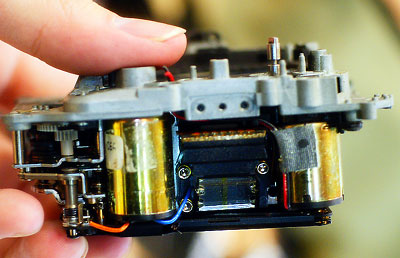
Two powerful motors – the left one advances the film at 4.5 frames per second, the right one definitely drives the screw that focuses the lenses. This was the fastest AF body in 1992 (and its motor was seen in the Minolta Dynax 7, too.)

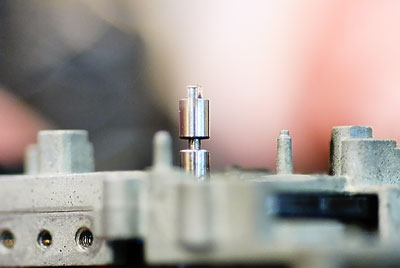
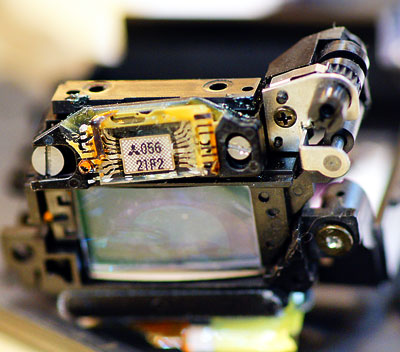
In between those two is the AF unit, with 3 hex screws. These 3 screws, accessible from the bottom of the camera under a sticker (which carries over to Sony dSLRs, even) can be adjusted to fix backfocus, frontfocus and alignment problems.


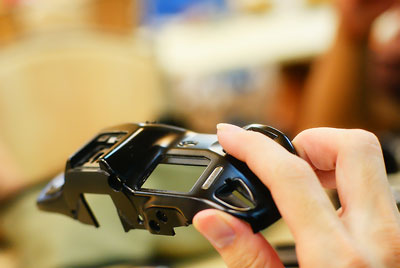
A rather dark screen. David the owner/hacker says Nikon did this part a lot better.


Of course, Minolta designed this better – the 5xi also has this wide grip. Notice that the thumb does not curl up at all. The thumb rests comfortably. While it did look odd when I saw a 7xi, I finally understood why.


Screw you. No, screw lenses.


This is as much as we could piece together. The AF/MF switch (below the lens release, not clear in picture) is not a switch but a spring-loaded toggle. Very useful (though a 2-position switch is easier for n00bs to remember if they’re in AF or MF mode.)

Justin then enforced brutality upon it to further disassemble the already broken shutter assembly.


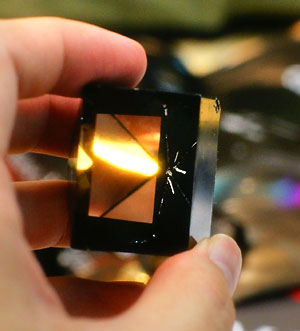
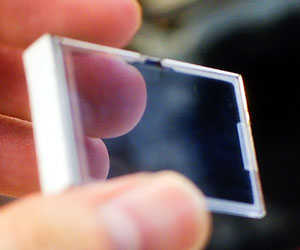
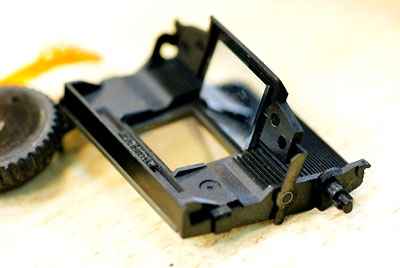
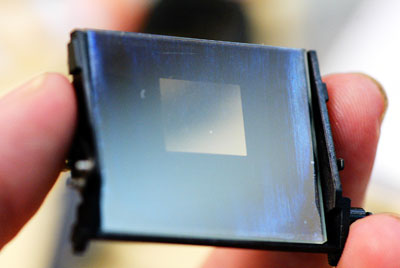
The mirror, and the half-mirror underneath that reflects some light to the AF unit below.


Very hard to wipe clean.


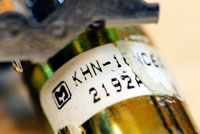
Internally, a lot of parts were Mitsubishi chips.


The shutter assembly was made by Nidec Copal Electronics.


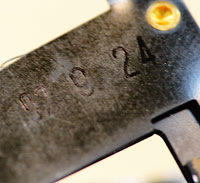
Date of birth. 24th September 1992.


Motor.


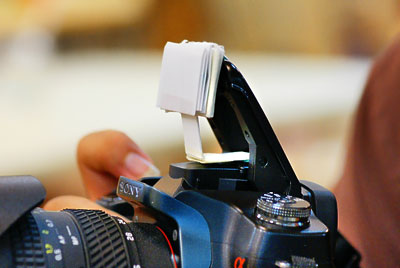
(Cut to Ament’s pop-up flash diffuser, blu-tacked to the hotshoe cover. What, your camera does not come with a hotshoe cover?)


Ament with the A-mount bling.


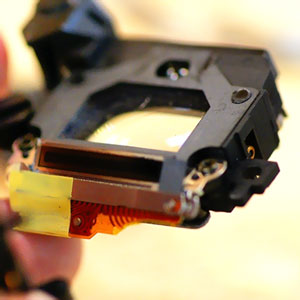
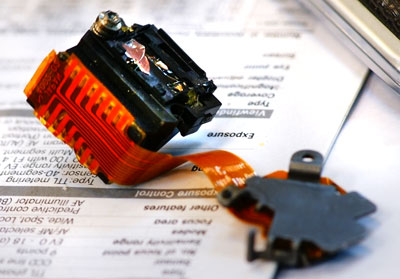
Justin enforced more brutality and got this – the AF unit. The shiny bits are the microlenses that focus light onto the AF sensors.


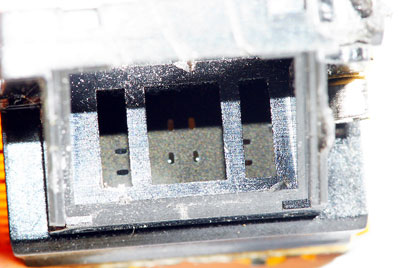
Four AF points.


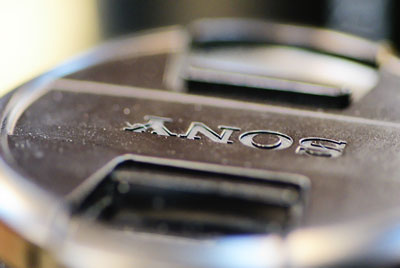
Surprise a lens cap shot! Oh, and all shots were taken with either my Minolta 50mm F1.4 or Justin’s Sony 100mm F2.8 Macro. It is a superb lens, with great liquid color and bokeh. I dare say better than the Tamron 90mm F2.8 Macro, because it does not make tiny specks look like donuts. The Tamron does that and it’s not pretty!

A200 and the 300mm!


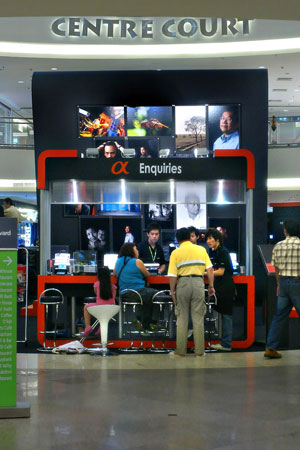
Shots from the Sony Roadshow in Midvalley Megamall:


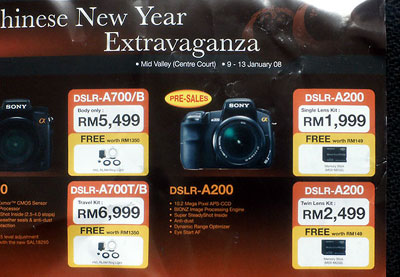
Pre-sale Sony A200 for RM1999 with kit lens and 2 GB memory stick.


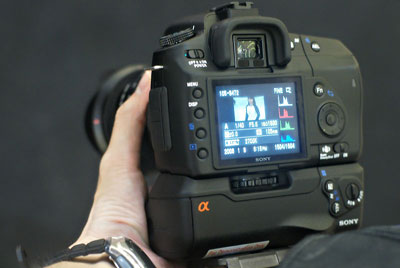
EXIF included.


100% crop of the ISO1600 image. To be fair, I picked a darker area of the picture to show you how much noise will appear in the midtones. It gets much cleaner in brighter areas.


EXIF included.


100% crop of the ISO3200 image.

It seems that the A200 lies somewhere in between the A100’s decent ISO400 and the A700’s decent ISO1600. I didn’t shoot at what would theoretically be the A200’s decent ISO800.


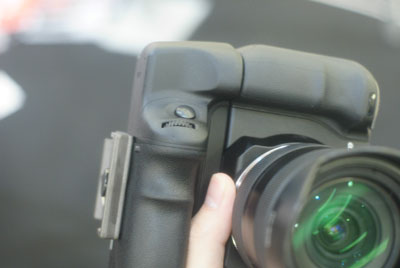
The camera feels nothing like how the studio shots portray it; the right thumb rests on a very, very nice candybar/soap shape. Some people have complained of the A100/A700’s “chins” stabbing the flesh of their thumb but I think this will not happen with the A200.

The buttons were a wee bit small (being used to A100 Nintendo-gamepad-size buttons.) The D-pad was excellent, even better than I remember on the A100. The body feels more unified, unlike the A100 which had different textures front and back.

I LOVED that the switches were much less rigid. On the A100 the AF/MF switch was a pain to flip. On the A200 it feels like a spring is helping you.

Quick Navi is not implemented as is on the A700, sadly – instead you press the Fn button and you see a menu of 6 functions. I prefer this to turning a rigid dial on the A100 as it’s truly all in your right thumb now!

When I tried the A200 with Sony 16-105mm F3.5-5.6 DT, I saw the focus slide smoothly in, and recognized that giddy feeling from when I first tried the A700. Yes, they got the fast motor!


It can track with 3 FPS with the 16-105mm. Comparing it with the A700 in 3 FPS Drive Lo mode it felt the same!

Of course, going back to a 2.7″ 320×240 screen is a bummer. You do feel it. They retain the speedy scrolling through images. Go Sony! (Show this feature off to Canon users, whose 40Ds will wear out fingers just rolling dials.)


More EXIF!


To be honest, I am not fully convinced on SSM, USM or SWM. They all feel the same – smooth, but not always working as easily as you’d expect on super tele lenses. It felt like when I touched a Canon EF 600mm F4L IS USM and wasn’t impressed.


The one shot that got away due to a safe ISO800 instead of ISO1600 on their demo A700 unit. If only I’d set it to ISO1600, you wouldn’t see motion blur as she flutters her eyes.


Bokeh is of course superb and liquid. I dare say it has liquid bokeh priority, sharpness second, ala Minolta.


Sorry guys, there is no Depth Of Field Preview button.

Funny thing is, the 3 main things that the Sony A100 had over all other brands, which I was proud to point out and used extensively, are missing in the A200.

– Direct Manual Focus
– AEL button becomes Spot Metering Toggle
– DOF button (which doubles as AE and AF lock, did you guess?)

So Neee-ar


Yes, the Sony Alpha 200 has been announced, as the successor to the A100.

Differences:

  • 2.7″ screen (A100 had a 2.5″)
  • ergonomics and more relevant buttons like the return of the ISO button, and something like Quick Navi on the A700. No more dialling with the A100!
  • improved noise control with ISO3200 maximum (to be found out, despite it using a 10.2 megapixel CCD sensor)
  • AF is 1.7x faster than the A100, with better AF tracking
  • quieter shutter sound (the A100 shutter sounded manly but loud, which some people may like)
  • auto pop-up flash (I don’t like it as I find this very annoying and n00bish, if I want flash I’ll pull it up myself. Fortunately it doesn’t in PASM modes)
  • battery indicator in percentage (A100 has 4 bars ala Nokia phones)


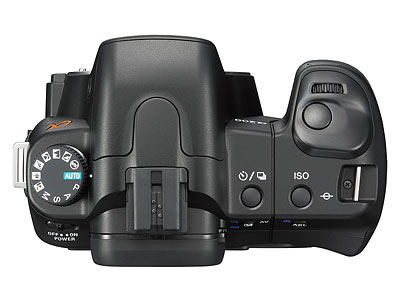
I love the top view design.

Personally, I prefer its design to the A100. There is a more streamlined design especially on the top, where it takes on the handlebar-shape of the A700. There’s no more silly A100 dial on the left; the ISO button returns, and you can see a silver O-ring like the A700 for future weather-sealed lenses.

The only thing I find kinda tacky is how they wrapped “10.2 megapixels” along the AF/MF switch.

You can try the A200 and A700 at the Sony Alpha Roadshow!

When: 10.00AM – 10.00PM, 9th – 13th January 2008
Where: Centre Concourse, Mid Valley Megamall

There’s also the Sony 300mm F2.8G SSM, which isn’t spotted in shops anywhere!

There are also contests – Alpha owners can enter a competition and win the Sony 16-105mm F3.5-5.6 DT, while those without can win a Sony H3.


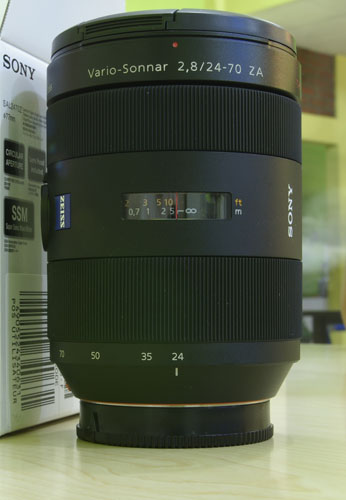
Also up and coming is the Sony Carl Zeiss 24-70mm F2.8 ZA with T* coating and Super Sonic Motor! This will be the Sony A900’s standard lens (or whatever they want to call their full-frame camera). To get this range on APS-C you’d need a 16-45mm F2.8.


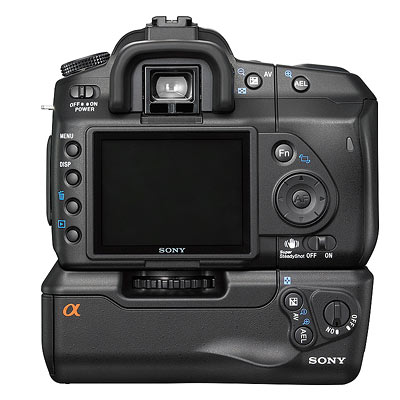
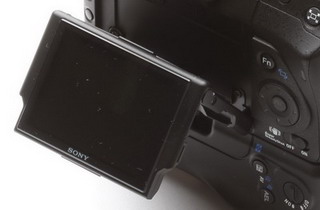
There’s also a leaked picture of a possible Live View swivel-screen Sony. The Fn button, directional keypad and vertical grip match those seen on the A200. There’s also a Live View button on the top-right corner! The vertical grip on the A200 is called the VG-B30AM (and not the VG-B20AM… which hints that the vertical grip was meant for something called an A300.)

Thus, we can guess that there will be a Live View swivel-screen Sony A300. It’s not using the A700’s VG-C70AM vertical grip so it has less buttons and thus, is less advanced than the A700.

Also, check out this video – Santana Featuring Chad Kroeger – Into The Night.

An unidentified camera, which seems to have the A100’s interface, may be another new development from Sony – it can trigger a flash without the pop-up flash being raised!

You can spot the camera at 1:46-1:56. It fires flashes magically! AMAZING!

I don’t quite like Chad Kroeger, or any of Santana’s rather bland recent stuff, but I felt a glimmer of hope when he did a rock-and-roll solo at 2:11. Though, sadly, that’s just rock-and-roll, nothing… Santana.

And now for some sad news.

Herbert Keppler, the former publisher of Modern Photography and Popular Photography (as well as being on the Minolta team when they developed the quick-release iTTL hotshoe) passed away on the 4th of January.

In Memoriam: Herbert Keppler, 1925-2008

His column, Speaking Frankly, is one of the very few that I subscribe to on Firefox. The moment I found it, I traversed the archives and learnt a lot more about camera and lens history.

White Canons

25th October 2007 – the Canon Expo at KLCC Convention Center!


A Canon Event Organizer shot by a Sony Alpha 700 by a Pentax K100D photographer.


Funky photogenic scenery.


I came for this! A chance to test the big whites.


Canon EF 600mm F4L IS USM on the (pulled off shelves due to AF problems) Canon EOS 1Ds Mark III. Fortunately they put this combo on a ballhead; unfortunately, I didn’t get to experience a crop factored 600mm. This was until recently the longest, fastest available lens.

This combo is supposedly the fastest and best in AF, for sports – however, I can’t say it was always good, and sometimes, surprisingly, this high-end lens would take slower than I’d want to get into focus.

AF according to Canon is done by checking focus once and telling the lens where exactly to focus. Once the lens has reached that supposed focus point, it checks again and does a micro-adjustment. It does not tell the lens to keep turning until it sees focus… (which is why camera makers have issues making Contrast-Detect Live View) so I wonder if it was USM on the lens being a bit slow to travel. Ideally, I should not see the view animating from out-of-focus into focus; it should jump in. It also took an uncomfortably long split second to kick in and realize that hey, I’m asking the camera to AF!

Of course, it didn’t hunt, which I’d attribute to the camera. Tracking works as expected, though I guess I have to get in tune with the camera because at times, it wouldn’t keep to the subject I was tracking and focus on something else.

As always, it’s fun to try to figure out how to use a pro camera. Took me awhile to delete pictures!

I also got to try the Canon EOS 40D. AF in Live View was iffy and I had to hold down the AF-On button until I heard the focus beep, and the 6.5 frames per second is a con job because you need a shutter speed of 1/500s or faster to achieve 6.5 FPS!


It can be differentiated from the similiar Canon EF 400mm F2.8L IS USM, which does not appear to have a little teleconverter on its back. That said, I can see the economy of getting a 400mm F2.8 and a 1.4x teleconverter to get 2 ranges.


Canon EF 100-400mm F4.5-5.6L IS USM. Push-pull and a birder’s paradise. There’s a Tighten-Loosen ring to adjust how smooth the push-pull zooming is. Very cool.


They also had the Canon EF 28-300mm F3.5-5.6L IS USM, which honestly didn’t interest me. It’s a heavy, heavily priced full-frame lens which is hardly bright, and photographers who can afford this would opt for two F2.8 or F4 lenses instead. It’s also a push-pull zoomer. The Tamron/Sony 18-250mm F3.5-6.3 DT is far more interesting given its price/performance ratio and groundbreaking performance for a superzoom.


I’m not sure whose front element this is.


KJ looking through a Canon EOS 5D and 400mm F2.8.

They also had the Canon EF 500mm F4L IS USM and Canon EF 300mm F2.8L IS USM but they weren’t as noteworthy as the lenses mentioned above, heh.

S.A.T.T.

Shots from a Sony Alpha TT session, 8th November 2007:

(TT = Teh Tarik, the Malaysian national beverage of conversations. Screw you Starbucks!)

Contrary to popular belief, I am not chief poisoner. kenki has managed to poison me!


The original Minolta 80-200mm F2.8G APO HS. You can feel the weight of the glass shifting as it focuses! Rare indeed for its 72mm filter thread.

I prefer this over the Sony 70-200mm F2.8G SSM. Its weight seems better distributed to the back of the lens. Although the Sony is 1340 grams and the Minolta 1280 grams, for 60 grams difference, it feels like a world of difference. Plus, HS (High Speed focus gearing) means arguably faster focusing on the Sony Alpha 700 than what a Super Sonic wave Motor can give.

I did feel that the HS was fast, perhaps faster than the SSM. Lenses with lightweight focusing elements, fast gear ratios and limited focusing range (like my beloved Vivitar Series 1 28-105mm F2.8-3.8) focus instantly without a doubt.

The Minolta 200mm F2.8G HS holds the record for zippy screw-driven focusing, though. Having experienced ted‘s 790 gram wonder for sports, I cannot imagine how much faster it can get if Sony puts an even more powerful focus motor in future bodies.


200mm F2.8 1/60s ISO1600 on my Sony A700.


Poor, poor lufiahs. I pity him, too.


The Peter Lim, or mac on PhotoMalaysia. 80mm F2.8 1.80s ISO1600. Check out teh_oo_ais in the background, who is in a very weird position!

Still, that wasn’t what got me.

It was this.


The Minolta 85mm F1.4.


One of the finest samples of Minolta bokeh at work. Second only to the Minolta/Sony 135mm F2.8/T4.5 Smooth Transition Focus lens. Crispy where in focus, a nice liquid blend where out of focus. 85mm F1.4.

Note that the Carl Zeiss 85mm F1.4 is not the same optically; while it is blisteringly sharp and free of chromatic and spherical aberration, its background does not blend as nicely due to its MTF-chart-topping high contrast design.


Alphaein. 85mm F1.4.


I love the naturally saturated color wide open! 85mm F1.4.


teh_oo_ice. 85mm F1.4. He is more in focus than if he was shot with a 50mm F1.4 because he has to be further away to fill the frame the same way.


Alphaein on macdude‘s Sigma 24-70mm F2.8 EX DG. At 70mm F2.8 it passed the misai test (when focused accurately of course.)


Thanks teh_oo_ais for taking this! 150mm F4 (which came from my Minolta 50mm F1.4 original + Tamron 1.4x 4-element teleconverter + Kenko 2x 4-element teleconverter.)


It seems like Ted will always always have a spy shot of him taken whenever he eats at A&W Taman Jaya.

KJ, Yo.


This is KJ.


Wah terror!” some bystanders say. KJ shot this, I think.


He might’ve shot this, too.


Yo-yos sit on his finger like a perched bird.


Flash, and some Photoshop, gives a black background.


Yeah he’s been doing this a while, as a professional yo-yo player even.


You might even spot him in a clown costume sometimes.


All of these shots are crops of the Peleng 8mm F3.5 circular fisheye through the Tamron 1.4x teleconverter (which gives a nice frame-filling shot and catches about everything I’d like to see without feeling like the yo-yo would smash into my camera anytime soon.) This is an uncropped, unprocessed shot to show what it originally looked like. There is a slight out-of-focus in all the images because it all looks in focus on the manual-focus Peleng.


A star for your efforts.

The Standard Ode

And now, for a dedication to my current always-on lens, the Sigma 17-35mm F2.8-4 EX full-frame A-mount lens.


With Creative Styles set to Contrast -3, Saturation +3 and Sharpness +3, I can get a very flat but colored image… which is an effect I like. Ohai Waifon! 😉


It focuses close to 50 centimeters only, with good sharpness at F2.8 and amazing clarity and detail at 17mm F4. Out-of-focus is not too contrasty though minor artifacts show in the far background.


Vote for me CLPVOTE Christy!


…because I sit and put my arms in a hexagonal nut position.

The infamous Sigma yellow is obvious but I like what it does for some pictures.


While I’d love a 16mm on APS-C, the 17mm is sufficient. I always felt 18mm to be not-wide… just accomodating for those people who’d step back to shoot crowds.


At 35mm F4, it has brilliant separation, with the background thrown into a subtly 2D look while I, the subject, looks 3D. A F2.8 or F2.0 lens will make the background too blurred out and make it unable to figure out what is in the out-of-focus area… while also making part of the subject soft and out of focus.

I also like the mottled, textured look of the greens.

The only problem with the lens is the Sigma yellow (though I don’t mind) and the brightline bokeh (out-of-focus points of lights appear to be discs of light with bright outlines… which can be easily Photoshopped. However, it has already made its effect on the railings which have faint borders.)

Some lenses make the backgrounds too contrasty and thus distracting. This Sigma, like (old) Minolta and Leica lenses, don’t, and concentrate on making pretty pictures. Understandably, Minolta worked a lot with Leica in the 80’s when the Minolta autofocus lenses came out, which is why the Minolta 70-210mm F4 beercan and Minolta 28-135mm F4-4.5 are highly regarded for beautiful bokeh and sharpness.

Unfortunately, Sony Carl Zeiss lenses are geared in the opposite direction – insane sharpness at the expense of less-than-Minolta bokeh. In out-of-focus areas, some midtones get darkened while some highlights get a boost in brightness. While it is still smooth-looking it does not look as calm.

Further reading:
Sigma 17-35mm F2.8-4 EX on the Minolta Dynax 7

Get Your Poise On

One night, Justin and I kidnapped KJ and brought him to a undisclosed location where he would be brainwashed.

I met my match, a Minolta lens geek who did some frankenstein lens hacking.


Guess what lens this was shot with!


Yes, it’s the old Minolta MD W.Rokkor 35mm F1.8. He duct-taped a MD-to-A-mount adapter to its base. It is beautiful wide open.


Then came this wonderful softie…


…the famous bargain, the Jupiter-9 85mm F2.0 lens in M42 mount. It has 15 aperture blades! However, it did nothing for bright-line bokeh… unlike the Minolta 85mm F1.4G which has one of the best bokeh renditions of the A-mount auto-focusing lenses. (The 135mm F2.8/T4.5 STF does not count despite being the best bokeh lens ever because it’s manual focus only.)

Now when I say bokeh, it’s a subjective term, but I mean a bit more than just “ooo wow big circles in the background!” The big circles have to be non-distracting.

Also, note that the Jupiter-9 did not have great separation when wide open. Good separation means that the background looks 2D and creamy, and not too contrasty… while the subject is 3D and has a pop that stands out from the background.

Speaking of which, the picture of the Jupiter-9 above was taken with my Sigma 17-35mm F2.8-4.0 EX at 35mm F4.0. Here, you see that the image is 2 distinct layers – the lens being held by my hand, and the blurred out background. The Sigma shows good separation here… and often looks better with better light.


Then there was this oddity…


…a frankenstein made of two lenses. The geek (who shall remain unnamed) combined a broken Minolta 35-105mm F3.5-4.5 with something else. I can’t say it was of functional use, though.


Then, we stalked a shop across the road!


This was a T-mount Maksutov MC MTO-11CA 1000mm F10 lens (note the DIY handle). The little dude next to it is my Peleng 8mm F3.5 circular fisheye (originally T-mount but with a T-mount to M42 adapter and M42 to A-mount adapter).


Catadioptric mirror lens!


Some kind of monster. The brand name is not even written on the lens!


Beware KJ for he is armed and ready to shoot.


Top: Tamron 200-400mm F5.6 on Tamron 1.4x teleconverter on Kenko 2x teleconverter on Sony Alpha 100 for 1100mm F16. Autofocus light enabled, focal length reported so it can use Super SteadyShot, can zoom, doesn’t have donut out-of-focus spots, lighter and heavier towards the mount which is good.
Bottom: Maksutov 1000mm F10 on Sony Alpha 700 for 1000mm F10. Focal length not reported so it can’t be stabilized, but it’s way brighter at F10. The lens is so big it is a challenge to fit your fingers in between to hold the camera grip!


Howdy.


Exactly 1 week later, Justin and I found that we had succeeded in our brainwash mission.