Category Archives: Pictures

The Jam And The Junction

11th May 2007 – the first gig I went to in the month of May. Yes, that’s right. Classic Rock night at KL Jamasia. For some reason, I wanna call it The Jam.


Azmyl Yunor, folk/blues rocker meets my Peleng 8mm F3.5 fisheye. Sony HVL-F56AM wireless flash from right, held by Xian Jin.


Crosstown Traffic! Hard rock heavies. Flash from left, held by me, shot by Xian Jin. Never has accidentally putting the flash in a shot looked so good!


They didn’t do Lynyrd Skynyrd – Freebird. Damn you drunken rockers! At least they did Cream – White Room.


Reuben on guitar.


Shot by Xian Jin. As you can see, it is often a great, great challenge to illuminate a scene with a flashgun and a fisheye lens.


He asked if he could get my flash dirty. Sure, why not?

I didn’t expect him to take a few shots in the middle of the non-existent moshpit, getting a lot of attention at it. As it turns out, he was trying to get the shoe to glow by sticking the flash inside… and the rest of it was trying to kill the light coming from the camera’s flash (which must be up to trigger the flash.)

Technically, three things could be done to kill off the light:
1) Use the darkest aperture
2) Lower the ISO (it was 200, when the Sony A100 goes down to 80)
3) Put an infrared filter in front of the flash commander (it will still trigger, but I didn’t bring the filter)


Then, there was Triple6Poser. Hard rock and them foot-stompin’ blues.


Flash pointed left makes for some interesting balance between flash and stage lighting.


Zubira!


Scalloped frets never looked better on my soft-focus combo.


They did a cover of Pink Floyd – Shine On You Crazy Diamond, this time without a keyboardist. Oh and some Indon rock band, and Free – All Right Now!


Lohan! Jangan lari! You gotta sing with us!


N. Rama Lohan has a pimpin’ velvet case for his Gibson Les Paul. Damn.


The next night, I was at Groove Junction for Aseana Percussion Unit. This guy has amazing vocals! He can do a Louis Armstrong impression.


They played mostly adult comtemporary songs from a time gone by.


You will be a belly dancer!


I love my fisheye.


Leonard the soundman.


This is as close as you can get to having a teeth solo on percussion.


Gotta have more cowbell!


Something tells me she won’t mind carrying such front-heavy weights in the foreseeable future.

I’ll get my spaceship to pick her up.


Prema on vocals. That makes like, 3 vocalists or something.


I’ve posted this shot before. I love it!

Sightings


Just when I thought it was an uneventful neighborhood…


Strange sightings are seen.


Random streaks of light.


The energy arced and entered…


My neighbor’s car. It was alive! It glowed like the sun.

How did I do it?

It was a power outage. These shots were actually at 8 to 9pm, 20th March 2007. All shots at infinity, 30 seconds at ISO100, mounted on a tripod, and then darkened if necessary. Shots #1 and #4 were at 50mm F1.4, #3 and #5 at 18mm F3.5, shot #2 at 50mm F3.5.

Shot #2 was me with a torchlight. Interestingly, the moonlight was strong all the way till 10pm, when the power came back on. I had no idea moonlight was so bright!

135 on 135

Backdated shots from the Auto Chinon 135mm F2.8 K-mount manual focus lens on my Pentax P30t, using Fujifilm Superia ASA400 film. All shots are wide open, at F2.8. Color balance has not been tweaked, but contrast increased ala high contrast paper, and minor sharpening to show the lens characteristics.


smashpOp is tired of posing while I manually focus, attempt to shoot… and find that the stupid P30t has swallowed yet another frame. I’d have to wind it again until I can shoot.


Oddly, bokeh is nice on the road curb, but rather bright-lined on faraway objects. It also does not look fully round, despite being completely wide-open.

Looking at the full-size scans, this lens isn’t sharp at F2.8. I have yet to find its sweet spot, though if I was to shoot at F4, my Minolta 70-210mm F4 beercan lens would already take care of that range.


At infinity. It has a built-in sliding-out lens hood. Pretty decent flare control.


I have to say, it does a superb job of bringing out the color.


Mere levels tweaking and the colors have punch!


Nearer to infinity, the effect of F2.8 on faraway objects is much less. However, the focus marks on the lens go all the way up to 30 meters!


Fujifilm film rocks. This shot shows very subtle light falloff and subtle chromatic aberration.


This is a crop; note the horrid bokeh on the trees.


This is way, way weird. Out-of-focus spots nearer to the plane of focus are nice and round, while distant spots take a weird octagonal shape.


I also brought it to the Guitar Artistic Series! 135mm F2.8 1/30s ASA400 to let in enough natural light, mixed with the Nikon SB-28 in manual mode bounced.


Fadlly. Hooray film for keeping the highlights from being burnt!


Looking at the shadow, I’m not so sure if I bounced it or went with direct flash.


You’d get equivalent brightness and field of view with a 90mm F2.8 lens on a digital SLR with 1.5x crop factor.


The hair on the back of her head is in focus, but the hair in front is out of focus. Sweet!

I don’t dare to put this on my Vivitar 2x matched multiplied K-mount teleconverter because the last time I did, it got stuck on it. I didn’t shoot with the Vivitar 75-205mm F3.5-4.5 either as my Minolta 70-210mm F4 already took care of that, and brighter, too.

Fee Shy!

One fine sunny day, I went down to Poslaju KL Sentral to pick up a package. Yes, a package shipped all the way from Canada!


The Peleng 8mm F3.5 circular fisheye lens for M42 mount.


I also ordered an M42 to Minolta AF A-mount adapter over eBay.


With the lens on the adapter, on the Sony A100. Note that MenuGearPage 2Shutter lock must be set to Off: no lens to shoot, as the Sony A100 does not detect any lens on it and otherwise would not shoot.


Sadly, the fisheye was misaligned; the markings were on the right-side of it. It cannot turn clockwise anymore in its M42 screw mount.

So what does an 8mm M42 mount fisheye do? 180 degrees of insane wideness, and distortion like no other.

Why didn’t I get the Sony 16mm diagonal fisheye, which has auto-focus, then? I wanted to use the much cheaper M42 mount lens on all my film SLRs. The package was supposed to include the Nikon F-mount and Pentax K-mount adapters, and color filters (screwed on the back of the lens) but none of that was included. Thus, I would not highly recommend Kremlin Optics, the online shop where I bought this, just yet.

Fortunately, the lens that came was well-coated, and was good and sharp. Russian-made lenses are solid. This was made in Belarus. The only sign of weakness would be the lens cap, which many have warned will lose its tightness.

Because it has 180 degrees of coverage there is simply no place for a lens hood. There’s no way you can put filters in front unless they were shaped like the front element.

Since it was an M42 mount lens, there was no way for the camera to tell the lens to stop down, thus you had to stop it down yourself by turning the Unlock-Lock ring as far as it would go. A separate aperture ring limits how far the Unlock-Lock ring will travel.

There is also a focus ring, but this lens, having such a short focal length, has such great depth of field that I rarely ever have to touch it. Considering the hyperfocal distance at F3.5 wide open is 1 meter, I can get everything from 50cm to infinity in focus by turning the infinity marker to the rear F3.5 mark.

If I stopped down to F16 (which doesn’t have any noticeable diffraction, wow) and set the infinity marker to the F3.5 mark, I’d have everything from under 10cm to infinity in focus. Interestingly, I could turn it way beyond the rear F16 mark (looping into the front F11 mark).

It would be pretty hard to conduct a test with a ruler extended to see how much DOF I can get close up, as the ruler would look pretty much in focus everywhere!


Left to right, top to bottom: Sony 16mm F2.8 with Tamron 1.4x teleconverter for 24mm F4.0; Sony 16mm F2.8; Peleng 8mm F3.5 with Tamron 1.4x teleconverter (for 12mm F5.0, note that the vignetting is gone); Peleng 8mm F3.5; Sony KLCC with the Sony 16mm F2.8; Peleng 8mm F3.5 represents what a fisheye is all about.

If vignetting is a big deal, a 1.4x teleconverter can solve that at one stop of light loss. The Sony 16mm diagonal fisheye would be great on a full-frame body, but is unfortunately not as fisheye as expected.


The Peleng is a sharp, sharp lens. Everything is already in focus; stopping down just sharpens the image. F8 is the recommended aperture for decent all-round crispiness.


A crop of the previous image. This was at F16. Blistering! I can feel my whiteheads.


A fisheye is a very interesting effect; it affects near and far objects differently; curved and straight objects differently; objects near the side and smack center distort differently. This shot of KLCC shows how skinny it can make something.


It also has uh… practical use, as I uh… took a picture of my phone.


Get in the action! Sony HVL-F56AM wireless flash fired to ceiling at 1/4th power, held up with left hand, camera in right hand.


So how does the Peleng do on my infrared-modded Fujifilm Digital Q1? Left is my Canon Powershot A520 at 35mm equivalent, and right is the Peleng on the Q1, for 8mm x 6x digital crop factor for 48mm equivalent. Except that it doesn’t look it, as it seems the fisheye is wider than a rectilinear lens of the same focal length.

Both shots are at ISO100 and F8. The Q1 got 1/500th of a second with all the infrared bouncing around, and the A520 did 1/50th of a second.


The fisheye can remove curves! KL Performing Arts Center actually had a curved dome, which has been straightened by the distortion.


Point-less photography. This cannot be any more convenient. Just hold the camera in the general direction and shoot. In this case, the HVL-F56AM wireless flash bounced against the cabinet walls.

We needed was a serial number off the back of the casing.


With the fisheye, you have to get close to get stronger distortion.

Note my shoe; it is quite impossible to get a shot of the floor without your feet unless you jump forwards, am free-falling or have mastered the art of levitation.


30 seconds, ISO100, F16, I think. The original was overexposed by 2 stops and was brought down in Photoshop. I haven’t seen enough clear night skies though. 🙁


Interestingly, the lens I am holding in my left hand is used to remove distortion by tilting and shifting the lens; the lens I have in my right hand is its worst enemy.

Yes, it’s the 85mm F2.8 PC Micro-Nikkor tilt-shift lens. I don’t quite get why perspective correction would need such a zoomed lens; a wide-angle tilt-shift would make more sense to the architectural photographers out there.


It is quite challenging to get flare with the Peleng. This was at F16. Because I had to stop it down before shooting, the sun wasn’t too glaring (though it would still be unsafe.)

The Peleng’s wide coverage will make any outdoor shot have extreme highlights and shadows. The Sony A100 chooses to underexpose, in which case it is wise to tap the AEL/Slow Sync button to spot-meter the scene. Alternatively I use Shutter Priority to have a quickly adjustable shutter speed, and use Aperture Priority with +1 exposure compensation.


There is a real macro mode if I remove the rear glass filter, making it short-sighted. Spot my feet!


TTL wireless flash almost certainly causes a spotlight effect, as with ultra-wide-angle lenses, unless the flash is placed far back or bounced to have wider coverage. This was at Cheah Repair, Mutiara Complex, Jalan Ipoh. I was testing my Minolta 70-210mm F4 beercan with the Tamron 1.4x teleconverter on a Minolta Dynax 5xi to see if it had the same compatibility problems with my Tamron 1.4x teleconverter.


It didn’t, so I went to Futuromic in Dataran Sunway one Saturday morning to find out if my Tamron could be rechipped. No, it could not, but at least while waiting for it to open I met the managing director, and we had a nice long chat while waiting for the technician. Futuromic brings in Tamron, Pentax, Ricoh and Nikon stuff, among others. Even the Pro Tama 0.7x wide-angle converter I had was brought in by them!

Nope, no scoop on the Tamron 70-200mm F2.8 price, though it will not come with any image stabilization so we know which systems will benefit from such a (presumably) well-priced lens.

I pitched to him the idea of having a weekday off and opening on a Saturday (they were only there because there was training) to cater to photography enthusiasts who have day jobs. I think a lot of old-timer camera shops could do with such an approach, getting more casual customers on weekends.


Walking on the moon.


Subtle distortion.


Draw a straight path from A to B…

How does the Sony A100’s Super-Steady Shot fare with such a short focal length?

Or rather, does it even know what the focal length of the lens is, and how does it compensate?

A shot in Aperture Priority, Auto ISO would wield 1/15s, ISO320, or 1/5s ISO100. Auto ISO works by increasing the ISO up to 400 if the shutter speed is slower than the inverse of the focal length.

Thus, the camera assumes that the focal length is 5 divided by 1.5 crop factor, 10/3 or 3.33mm.

Surprisingly, much longer lenses like the Sony 500mm F8 reflex lens on my Tamron 1.4x teleconverter (making a 750mm F11) still get stable at 1/80s despite the camera not detecting the lens (due to incompatible teleconverter.)

I simply have no idea how that works.

Anyway, I have yet to encounter handshake with the fisheye. Then again, I haven’t shot much near 1 second handheld, though the formula for Super-Steady Shot promises 1 second.


Now on to shots with the Pentax P30t on Fujifilm Superia ASA400 film! I brought the Pentax out while picking up the lens so I could test the full-frame glory, but alas the adapter was not in the package as promised!


This was actually overexposed due to the P30t being cranky. Amazingly I could bring it down from its 1 second exposure.


I also tried the Pentax 10-17mm fisheye-wideangle zoom on my P30t!

The Peleng 8mm F3.5 circular fisheye has to be one of the best buys I’d ever made. You don’t get any wider than this (except the 6mm F5.6 Nikkor that does 220 degrees and catches your hands holding the camera in the shot). Plus, the immense depth of field means no more focusing lag. The immense field of view means no more pointing. The only thing I’d need to concentrate on doing is to get the camera into the heat of the action, at which point holding the camera on a tripod and aiming it like a mike boom with a shutter release cable would work.

After currency conversion, the lens and adapter came up to under RM1400.

I would not recommend using M42 lenses for auto-focus SLRs, digital or otherwise unless you:

– have changed the viewfinder to a split-prism viewfinder for easier manual focusing
– can live with manual focusing in dark conditions and am not in any hurry
– have no money, but want a 85mm F2.0 lens

If you have to get M42 lenses, get the wider ones like the Peleng 8mm F3.5 circular fisheye or the Zenitar 16mm F2.8 diagonal fisheye.

O Sim-ulation

As a connoisseur of massage equipment, whose fine practice has been refined back while waiting for ever-so-punctual friends, I can thereby declare OSIM’s uPilot… the best there is.

This effectively dethrones their previous top model, the iDesire. With hand massagers that looked like a comfortable bondage chair, and a distinct head-slapping program towards the end, a grown man could experience what it is to just lay back for 15 minutes and have an orgasm.

OSIM is the only massage equipment company that has successfully made products that consistently make me feel good even when I get up. Some hurt me and feel good after I get up; some feel good but hurt after I get up.

So what’s new with the uPilot? Ultimately, the joystick lets you control the rollers/slappers. You can make it sink into the couch for less power, or make it push you up. You can shift it from your lower back to your neck.

Yes, just like telling the masseuse to go up a bit and work on your shoulders.

A good massage is usually of the harder variety. Anyone who has ever been for the real thing would know. Don’t tingle and giggle. The octopus/jellyfish move, which creeps up the scalp, is tingly at first, then you brace the fact that having your brains sucked out like a coconut is bliss.

Some ask how I do it so well. Simple – you massage a friend like you wish you’d like to be massaged at that moment. It works. Heck there have been times where I’d need a massage bad, but headed over to knead some random colleague and I’d feel much better.

When I am old and retired, I will want to have children who are a benefit to society. I wouldn’t want just a dumb corporate slave. I already won’t force them into boring stuff like accounts or law (though, if they go into law hardcore, I don’t want to pick up death threats for them.)

At the very least, they should earn enough to buy me a massage chair.

Rock Out!

On the 16th of May, 2007, 11:30pm, I was in Midvalley, having finally watched Spiderman 3. (Thanks Chez!)

As we walked to the toilet, loud music blared through the public announcement speakers at maximum volume. It was Gary Moore! It was his extended Still Got The Blues shred! I was like, “YEAAAHHH ROCK ON MIDVALLEY!


The rest of the crowd did not think so. Girls covered their ears, and guys could be seen with white papers crumpled up in their ears! This was a primarily Chinese crowd, though.

(Pardon the quality; it was a screen capture of a video recorded with my Nokia N70.)

They played a hard rock greatest hits CD. Guns & Roses – Knocking On Heaven’s Door, Ugly Kid Joe – Cats In The Cradle, Creedence Clear Revival – Have You Ever Seen The Rain?, Def Leppard, Scorpions etc.

As we went around the mall, I was hoping to spot a group of Malay mat rockers in a corner somewhere, with skinny torn jeans and a curly mess of long hair, and air-guitar along with them.

Unfortunately, I did not spot any even in the car park where it was still blaring away.

I was enjoying every bit of it.

The next night, I was there at a similiar time, but the music volume was considerably lower. Also, because I had just watched Sumo-Lah! with a Malay crowd, they did not seem perturbed by the music at all.

I wish I whipped out my camera; instead I was trying to record a video of people looking annoyed at the music.

Drummah!


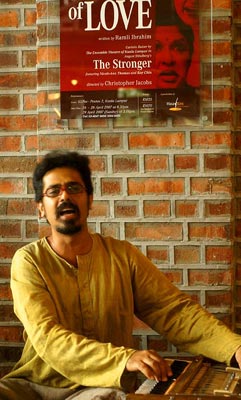
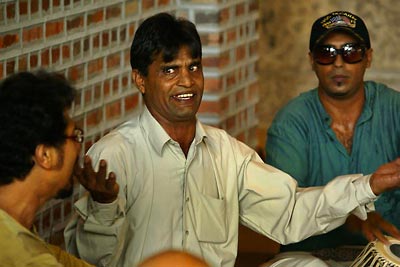
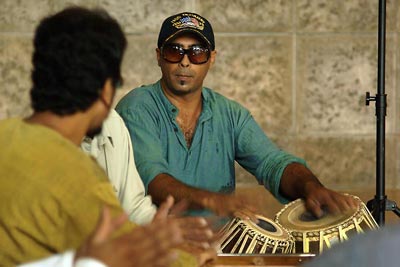
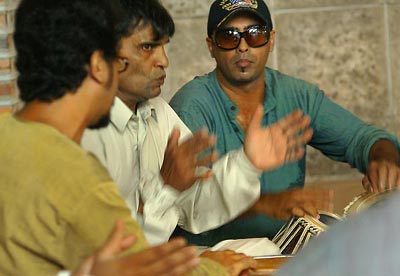
22nd April 2007: My day was filled with percussion, before and after Screwed.


Ghrana! Performed by the Sikandar Arts Academy.


Hey!


This is Sufi Culture. This is the KL Performing Arts Centre.


Modern Qawali. Ghazals and Ragas.


Clap that.


Yeah, I’m just paraphrasing their site. They were in The Actors Studio for a stint.


And after Screwed, I landed in Tugu Negara, for the Tugu Drum Circle!


Bought a djembe and wondered why it didn’t sound so nice on its own? Bring it out to the drum circle! They meet every Sunday from 5:30pm onwards.


Dhol, baby.


The interesting specimen! So this is where you come from. For bringing me to your turf, thanks babe!


Goes on into the wee evening where the mosquitoes come out to play. Them mosquitoes, they love a good rhythm. No wonder they come for me, I shake my legs a lot.

Look for Paul or Shady; those guys will teach you basic rhythms.

Solve The Softie


Guess what lens this was made with!


Or this!


And this!


Or Cherrie‘s massive teddy-bling phone!


Yes, that’s right; it’s the Sony A100 with Tamron 1.4x teleconverter and Minolta 50mm F1.4 lens and Pro Tama 0.7x wide-angle converter!

This particular picture includes a +2 and +4 closeup filter for even more macro softness. However, in most cases I won’t shoot macro with this combo; or rather, the 1.4x teleconverter keeps the minimum focusing distance while multiplying focal length, so you can get more magnification even without a closeup filter.


Another way to deck it out is to stick a 77mm CPL in front of it.


I took it out for a spin in the neighborhood playground.


All shots are wide-open (the 50mm F1.4 would become a 75mm F2.0) for maximum softness. I could still stop down the lens and get quite a lot of softness.


I’ll help you down.


As long as there were highlights, the HDR-like look seen in Half-Life 2 can be seen.


How does it compare to the Minolta/Sony 135mm F2.8 Smooth Transition Focus? Honestly, nothing is like the STF lens; the STF lens is manual focus only, with the depth of field of a 135mm F2.8 lens but with the transmission of a F4.5 lens (meaning that it lets in less light). Turning the aperture ring from T4.5 to T6.7 results in the right-side image. Note that the bokeh is never harsh or hard, and very very creamy.

Being a manual-focus lens with an effective F4.5 brightness however, it is limited to portrait shots in bright daylight. (Be sure to put some greenery behind the subject.)


Left: Minolta 50mm F1.4 lens alone; right: softie combo, which seems just a bit longer.


On to impromptu camwhoring!


Yes yes this corny effect can be duplicated in Photoshop, but nothing beats seeing it right out of the camera.


Beer ad. Yum yum.

Super Massive Geek Yo

Alright, it has been a while since the last camera geek out post. Here goes!


Build your own flash snoot to concentrate your flash light into a tiny spot. Bottom-left shows the flash zoomed to 85mm; bottom-right shows the flash with snoot.

The cardboard was packed too tightly and it was too long. It made too small a flash spot for my liking.


Albert Cheah of Cheah Camera Repair, Mutiara Complex, Jalan Ipoh. Friendly and knowledgeable guy, who does a heck of a great job defungusing lenses. He also has an array of rangefinders for sale in a glass case.

His workspace is open for all to see, which assures you that he is the expert tinkerer.

I’ve sent two cameras to Desmond of YL Camera, Pudu Plaza, but they could not completely be fixed and had some residue kinks. (My Olympus OM-2000 can shoot frames even with the film winder locked, and my Pentax P30t often swallows frames… so I have to wind the film again although I have not shot.) To be fair, I don’t know if it’s the cameras that were beyond repair.


Clockwise from top-left: Tarquin’s Canon EF 100mm F2.8 life-size macro lens next to WKCheang‘s Nikkor 105mm F2.8 VR life-size macro lens; Tarquin rolling a 120 black-and-white film; a Canon 7 rangefinder with a 50mm F0.95 lens; WKCheang’s Nikon D200 with the cute Sigma 30mm F1.4 lens.


Jenhan models my infrared-modded Fujifilm Digital Q1 with the Soligor 70-220mm F3.5 OM-mount lens. With the Vivitar 2x teleconverter, it gives an insane 2640mm equivalent focal length.


At YL Camera, I tried the Tamron 17-50mm F2.8 lens for Minolta/Sony A-mount. It is easy to see why this sells well; people love bright, reasonably-priced lenses. It wasn’t soft wide-open, and decently sharp (I only shot at F2.8 though.) This was at 50mm.

Would I buy it for my Sony Alpha 100 if my Sony 18-70mm F3.5-5.6 kit lens got eaten by an Earth Elemental? Yep.

The classic Tamron/Minolta 28-75mm F2.8 lens would be given due consideration, too. I could pop a 0.7x wide-angle converter to get the 18mm feel on digital SLR crop.

However, the temptation to get wider is strong, and skip the in-between focal lengths. The Sigma 10-20mm F4-5.6 lens, with 1.5x digital crop, would give a 15mm view on my Sony A100. It accepts 77mm filters, which is a bonus for polarizers and infrared filters. However, the Tamron/Sony 11-18mm F4.5-5.6 is quite viable, having a 77mm filter thread and the ability to be used on a Minolta film SLR or the upcoming Sony full-frame digital SLR with no vignetting at 15mm. The Tokina 12-24mm F4 is lacking in this department; its vignetting is gone only at 16mm, and there is a huge difference between 10, 11 and 12mm.

For truly wide rectilinear shots, a film SLR with the Sigma 12-24mm F4.5-5.6 full-frame lens is superb. However, the lack of a filter thread means I can’t put it on digital and shoot infrared. 🙁


I got myself a 55-77mm step-up ring for RM25 and a Sakar 77mm circular polarizer for RM55. (Two CPLs side-by-side reflect different colors when rotated.) These things are amazingly cheap at Digicolor, Mutiara Complex! You can see my Canon Powershot A520 with lens adapter, 52-55mm step up ring, 55-77mm step-up ring and 77mm CPL; the other setup has a 55-58mm step-up ring and 58mm Pro Tama 0.7x wide-angle converter for 24.5mm feel. There’s also the Sony A100 with Sony 18-70mm F3.5-5.6 lens, 55-77mm step-up ring and 77mm CPL, and a wide variant with 55-58mm step-up ring and 58mm Pro Tama 0.7x wide-angle converter for 18mm feel.


Have you seen one of these pop-up books? Awesome. This one was very educational, with all sorts of gimmicks to teach photography principles.


Tarquin’s Yashica-Mat with 80mm F3.5 lens and 80mm F3.2 viewing lens!


The Yashica MG-1 rangefinder with 45mm F2.8 lens.


My Pentax P30t with K-mount to M49 adapter, and the Olympus Zuiko 50mm F1.8 OM lens reversed on it. This is not my recommended method of shooting life-size macro though. I’d rather you reverse this lens on another lens as it is safer and gives you more flexibility.


Similiar setup, but with my Fujifilm Q1 with homemade Olympus OM adapter stuck to it. Yes, the Q1 can actually see something.


The great Minolta 7000 wearing my Minolta 70-210mm F4 beercan lens! It was the first properly-implemented auto-focus SLR. For its time, it was the fastest; I still find it pretty alright, though the motor sounds like a Tamiya motor, and when it advances the film it sounds like it’s ripping it apart.

I could actually walk around with this, since I had with my Sony A100 and Minolta 50mm F1.4 (giving a 75mm equivalent, which isn’t as wide.)


Left: The Minolta 7000 came with a Minolta 28-85mm F3.5-4.5 lens with macro switch. Interestingly, the macro switch allows you to zoom out to get macro, instead of zooming in to get macro like every other lens. 1:4 magnification is possible, though working distance is small at 28mm. On the plus side, it’s F3.5 and there will be less shake. I did not buy this; I’m holding back for a less noisy Minolta AF film body. Within minutes I could figure out the 7000’s controls. Very user-friendly!

Right: The famous Pentax SMC-FA 77mm F1.8 Limited pancake lens. Tiny, bright, and very desirable. Very very sharp wide-open, with a 3D pop to images. Also has a velvet inlay. Sweet.

The Minolta 7000 could use my Sony 18-70mm F3.5-5.6 lens at 24mm without vignetting, which was cool.


Man spotted next to Pudu Jail. I have no idea what he was collecting.


I headed to Keat Camera to get myself the rare Tamron-F 1.4x Auto-Focus 5-pin teleconverter for Minolta AF mount. It would multiply the lens’ focal length by 1.4x and decrease its maximum aperture by 1 stop.

It is a screw-mount teleconverter, which means it will transfer the focus screw turns to the lens. It will not work with Minolta/Sony G lenses which have focus motors in the lens itself; for that, the Minolta/Sony teleconverter should be used instead.

This picture shows my softie combo; the Minolta 50mm F1.4 has the teleconverter on its back and a wide-angle converter in front (which cancels each other out but exaggerates spherical aberration.)

Sadly, AF would only work completely on the Minolta 50mm F1.4 (which now was an effective 75mm F2.0 according to the EXIF data). AF on the Minolta 70-210mm F4 would work at 210mm and infinity, but when I tried to focus and it turned towards close focus, or when I tried to zoom out, it would ‘disconnect‘ the lens and be unable to send the aperture to the Sony A100.

It would read the aperture as “–” and be manual-focus only. I would not recommend stopping down due to exposure errors, and because whatever lens you’re putting on is going to be darker.

However, the beercan on the teleconverter worked fine with the Minolta 7000, as the teleconverter manual promised.

Now you may ask, why does the teleconverter report 75mm instead of 50mm x 1.4 = 70mm?

I tried my Sony 18-70mm F3.5-5.6 and zoomed it to 70mm, focused on infinity (to prevent focus from changing focal length), shot a frame, then popped the 50mm with 1.4x teleconverter, focused on infinity, and found the 50mm combo to be more zoomed in. Thus, the 1.4x teleconverter really had a 1.5x focal length multiplier.


Still, it does not rob from the beercan’s sharpness; it becomes a usable 300mm F5.6 lens (as reported by camera EXIF). I was pleasantly surprised to see how sharp it was. The teleconverter had 4 elements, and did not add to the reputedly bad chromatic aberration of the beercan. It also did not add spherical aberration, unlike what it did to the Minolta 50mm F1.4!


Another 300mm F5.6 shot.


A crop.


Excited, I headed over to Sony, KLCC to try my teleconverter. I tried the Sony 500mm F8 Auto-focus Reflex lens, which became a 750mm F11 (sadly, no aperture reading, so it was manual-focus only).

The shot in the bottom-right corner, however, was with the Carl Zeiss Sonnar T* 135mm F1.8 ZA lens. (Also no aperture reading, due to old teleconverter being mostly incompatible with digital bodies.)


CZ 135mm F1.8 with teleconverter. The Carl Zeiss is so sharp, the teleconverter’s effect is minimal. It is still razor-shave sharp (or rather, it makes it obvious you haven’t shaved.)

The math says it becomes a 200mm F2.5. Yes, 200mm F2.5! Not just some 200mm F2.8.


Without the teleconverter. Pardon the focusing point difference.

If I could get a newer teleconverter that was guaranteed to work on the screw-mount lenses on a Sony A100, this would be a very practical option.

Would I get a 70-200mm F2.8? Not likely. The 70-210mm F4 beercan, 1.4x teleconverter and CZ 135mm F1.8 make the best, light tag team. Any 70-200mm F2.8 will weigh at least 1.3kg and cause photographers to whine of sprained arms. The 135mm F1.8 however, is the brightest and longest prime (by dividing 135/1.8 = 75mm). It is beaten only by the 300mm F2.8.

It also looks stumpy and short without the lens hood, and a lot less suspicious than the 70-200mm F2.8.

Why not a more practical 85mm F1.4 then?

I already have a 50mm F1.4, with 1.4x teleconverter to make a 75mm F2.0. It would be a bit redundant, plus I find myself zooming in, using the end nearer to 210mm on my beercan.


Jenhan is surprised to see how crispy the Carl Zeiss 135mm F1.8 lens is.

I am practically sold on this chunk of solid metal. It feels like a sawed-off shotgun. A black cannon.

The 135mm F1.8 also renders near-focus areas differently; it is sharper and makes the depth-of-field seem deeper than my 50mm F1.4. The Sony 70-200mm F2.8 is no doubt creamy, with good subject isolation, but I already have the lightweight beercan for that.

I don’t tire of holding the beercan; it weighs under 700 grams, and I can switch to portrait orientation without feeling the strain.

If you had a Canon SLR, I would whole-heartedly recommend the Canon 70-200mm F4L IS USM with Canon 135mm F2L USM combo. (You could whine about not having F2.8 but you guys got clean CMOS sensors so pump up your ISO!)


Finally, Tan Yee Hou, Tan Yee Wei and I could drive to a market and open shop.

I don’t even know where to start labelling; there’s a Pentax P30t SLR, Olympus IS-1000 zoom lens reflex, Ricoh 500G rangefinder, Olympus OM-2000 SLR, Canon EOS 650 SLR, Seagull SA84 twin lens reflex, Canon Powershot A520 digital camera, Ricoh XR-10 SLR and a Fujifilm Digital Q1 amongst various lenses. Missing is an Olympus mju, a Panasonic FZ-30, and my Sony Alpha 100 used to shoot this.

With my collection of cameras of different mounts and brands, a worrying thought came:

If I ever get stinking rich, I might possibly practice polygamy. Legally, of course.

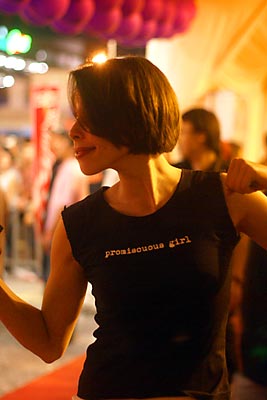
Promiscuous-tee

And now, for a contest!

The first female who can tell me what the word “promiscuous” means will win a free baby-T.


Yes, the one Natalie is wearing. It says “promiscuous girl” on the front, nothing on the back, full black, cotton, S size.

Of course, if you can prove to me that you are a promiscuous girl, you will get it first. 😉

And yes, I did a survey, and found that most girls singing the horribly catchy tune did not know what it meant.

How did I get it? I entered the VIP area of the hitz.fm 10th Birthday Bash, and I got a goodie bag. I thought it was the “JJ and Rudy Gotcha’ed me and all I got was this lousy awesome T-shirt” (for guys) but got this one instead.

Terms and conditions: I should have an idea who you are and how to pass you the shirt in person. 😛