Category Archives: Geek

October In A Flash

It’s the end of October, and it’s Stock Clearance time! Random unrelated pictures with some helpful technical details follow.


Paris Hilton’s album launch at Zouk, with emcees Joey G and Paris Hilton Daphne Iking.


This was in Manual Exposure mode; when flashing, there are a few variables that control the exposure of the flashed subjects and the unflashed subjects, namely:

ISO – increasing the sensitivity makes the flash appear to reach further. It also increases the brightness of the unflashed subjects.
Aperture – same effect as ISO; brighter apertures (e.g. F2.8) make the flash appear to reach further, and brighten the unflashed subjects.
Shutter Speed – choosing a slower shutter speed brightens the unflashed subjects. Faster shutter speeds can kill off the light that is present, so choose 1/500th of a second to make it seem like the only light is the flash. A slow shutter speed can leave motion trails on a moving flashed subject, or leave some colored lighting on the flashed subject.
Flash intensity/power – a more powerful flash reaches further. In this case, the flash power is at 2/3rds (so it only hits the front dancers and not the back dancers.)


Cindy! These are the same ol’ dancers I see everywhere!


Flash the smoke!


I say to Cheryl: I’ve got a tent. 😉


Ooo. Smoke.


What’s up dog?


And now, for more pussy!


Stalker.


Stalked.


Laundry Bar’s furniture doesn’t look so cool in daylight.


There it is, for everybody who doesn’t know where to find Laundry Bar in The Curve; it’s under that pointy dome, near Cineleisure.


I like how the wheelchair dude gets mall wall space.


Ciplak plays dress up every appearance.


A normal macro shot of a not-found-in-Malaysia Nokia phone.


If only I had second-curtain flash.


The difference between a bright and dark aperture; left: F2.8 is a bright aperture; right: F8.0 is a dark aperture, needing slower shutter speeds, but lets more objects appear to be in focus.


We now proceed to the National Science Center. When I was a kid I always wanted to be an inventor!


Wow, a wau.


Now that’s fun.


Corny heart.


More flash balancing, featuring smashpOp and Kingsley.


Left side, top to bottom: A 52-67mm step up ring and a 67-72 step up ring; my Fujifilm Digital Q1 manual-focus infrared-modded camera with an empty 52mm ring superglued to it; so I can screw filters in front of it, (though I have to remove filters to focus) ending with the 52-67 reverse macro adapter, which makes it kinda cute.
Right side, top to bottom: The two rings were superglued, so they are male on both sides, at 52mm and 67mm, to make a reverse macro adapter to mount Paul‘s Nikkor 50mm F1.8D lens in front of his Nikkor 18-135mm F3.5-5.6G lens to make supermacro like this hole; me behind the adapter behind my Canon Powershot A520.

Speaking of supermacro, check out this guy’s setup on a Canon Powershot A70; he did it way back in 2004 with a flash, even! (However, gluing two equal-sized threads may not give as much surface area.)

Texmax

Here comes more of that supermacro shiznit.


Velcro.


Bedsheet.


Dust bunnies. (The next instalment will have something even more gross.)


The Nikon Coolpix 2200 I broke.


High strung.


Okay, so this is with smashpOp‘s old Panasonic FZ-5 at 432mm full zoom.


Infrared version of the first shot.


Wet head.


Whee! (Had to use the flesh-colored flash technique.)


None of these shots were cropped. This ruler shot is to show the scale of how small an area I could capture at full zoom (140mm equivalent).

According to this:

http://www.dpreview.com/news/0210/02100402sensorsizes.asp

My Canon Powershot A520 sensor should be a bit wider than 5.3mm. 5.3:15 = 1:2.83 macro, technically, not impressive. However, a dSLR with 1.5x crop factor would have a sensor 36/1.5 = 24mm wide. 24:15 = 1.6:1 macro. So, to get 15mm to fill a dSLR frame would need a 1.6:1 macro lens.

And now, for some super macro shots!


140mm film equivalent focal length. In other words, zoomed all the way in on my camera, but using the reverse macro trick I can focus that near.


The wheels stopped turning and the spark is gone. To get this lighting, I had to use flash, and bounce it towards the subject by putting my left hand over it like an umbrella. It gives it a nice warm tone anyway. 😀


Gross.


Pointing a supermacro setup at spotlights make for interesting bokeh.


Transformers Cybertron Downshift, also using hand as a flash reflector.


Three lost screws from the Nikon Coolpix 2200 I disassembled.


This eye has probably seen more trashcans than I have. (I’ve tried with a tripod but focusing it is very hard. So hard, I have not succeeded.)


Hair looms. (This was the only picture that was cropped; the rest were really shot at that magnification.)


Guess what this is.


…and you might get this.

Also, check out Paul’s macro shots which he took using my Fujinon 50mm F1.4 lens, attached to his Nikkor 50mm F1.8D on his Nikon D80. I’m pretty sure I took that picture of the fly as he had trouble focusing on it. 😛

While at it, check out Paul’s Railwayday shots for some excellent moods in photos. And there he was, looking as uninspired as I was when I said I didn’t feel inspired to shoot anything at the KL Sentral KTM station.

DIY Super Macro!

This post is way backdated (June), but will be one of the biggest geek posts I had. Beware the geek attack, get your inhalers ready!

Ever wondered how photographers got shots like these?


1/100s, F8, ISO50, 85mm film equivalent

They either bought a SLR and put a macro lens on, or they used the cheap reverse macro trick. There are a few ways to do this:

1) Take out the lens of an SLR/dSLR and turn it backwards. Yeah, make it look like you’re putting it on… the wrong way. Of course, this is not safe because dust will get in, and you’d have to guess your exposure, and focusing is by moving closer or further from the subject.
2) Same as step 1, but buy an expensive reverse mount adapter.
3) Reverse an SLR lens and attach it to the front of your camera. Your camera’s lens needs to have a screw thread (most prosumers do) or a lens adapter that has a screw thread (Canon Powershots and some Sony point-and-shoots have it). Of course, if you are using a SLR/dSLR, your lens will almost always have a screw thread.

The problem with 3), of course, is that when you reverse an SLR lens, both sides are female! One lens has to screw onto the camera’s screw thread.

Therefore, you could buy an expensive (and hard to get) reversing ring (which has male screw threads on both sides) and screw the lenses together.

Or… you could go my DIY budget way, which is even cooler.

I visited my favorite camera shop in Ampang Park, Leos Com Trading, to ask if he knew about this reverse macro thing which I’d read about.

Oh yeah! You mean this?


He took out a Fujinon EBC 50mm F1.4 lens, which had been stripped of its casing and wrapped with cellotape. Its screw thread diameter was 49mm. He donated it to me, knowing my experimental efforts in cameras.


I could see why it was junked; it had 6 aperture blades, and when the aperture was closed, it made a teardrop shape instead of a circle. This would mean that it had lousy bokeh. Its screw thread was also dented, so you could not put a UV filter on it. Finally, Fujifilm’s digital SLRs use Nikon mounts… so this lens was homeless.


The lens could be further disassembled, but I didn’t dare do it just to count the number of glass elements in it.

He also had some dirty secondhand UV filters, and donated a 52mm Vanguard Skylight filter. 😀


I wrapped the filter in A4 paper, gave it an impactful hit (no glass cutter needed for this one!) It was then superglued to the outside of the Fujinon lens. (I could not screw any filters in because it was dented!)


I could finally screw it on to my Canon Powershot A520! The black tube is the lens adapter, which allowed me to attach 52mm-diameter converter lenses and filters on. (I need to zoom in a bit or shoot through a circular window because the end of the lens is smaller.)


I could also put filters before the lens and keep them that way.


Because the Fujinon lens now had a 52mm-diameter male screw thread, it could fit on any lens with a 52mm diameter screw thread, like the cheap and well found Nikkor 50mm F1.8D lens. (Paul makes the Nikon D80 look tiny!)


smashpOp seen here with a Nikon (gasp!) Okay, so it’s Rames‘ Nikon D50 with the Nikkor 50mm F1.8D lens as well. smashpOp is parodying Rames and every other person who buys an SLR, and the very first picture they take, is of the lens cap.


Pinkfrog need only put a 55mm to 52mm step-down ring to attach the Fujinon lens to his Panasonic DMC FZ-5.

So what about SLR lenses that have bigger sizes?


Pinkfrog has a Tamron AF 70-300mm F4-5.6 lens (from his Nikon F90) which has a 62mm diameter screw thread. He also recently got a Nikon D80 with that Nikkor 50mm F1.8 lens. It was my job to marry them. How? The 70-200mm was fitted with a second-hand 62mm Sakure UV filter (also had its glass broken) and the Nikkor 50mm F1.8 lens was fitted with a 52-58mm step up ring.

We then superglued the rings together!


On top is the silver 52-58mm step up ring, superglued to the female side of the 62mm UV filter. Yeah, you could say that they were lesbian.

The rings must be differently sized, but close in diameter. It might not stick properly otherwise. Common sizes are 49, 52, 55, 58, 62, 67, 72 and 77mm. I suppose that the difference in diameters must not exceed 5mm so that there would be enough contact surface.


If you don’t mind not having a lens cap, you could leave the DIY lens reverser on.


It’s a step up so there’s no vignetting.


BAMF!


How close can you get? Safely under 5cm. Of course, this was on the 300mm (450mm film equivalent) side, so it became a very long magnifying glass. Through this setup, I could see the texture of the keys… and I had to move the lens about to look at the arrow he was pointing at. Yep, half the arrow filled up the frame! (The more observant of you would notice that the camera was off because he ran out of battery power.)

Aperture was controlled by the camera (on the 70-300 lens) or on the reversed lens (which fortunately had an aperture ring.)


One could also swap the lenses’ positions. Of course, this is a dummy shot, because:
1) The camera is off.
2) The lens hood is pointless in macro, as it will block out well-needed light, and perhaps scare off insects.
3) The lens hood only fits when the protective cap on the SLR side is on.

Anyway, on to a teaser shot.


Even at dark apertures like F8, this flower still had a very shallow depth of field.

Precautions
Do not use auto-focus! The lens that is reversed is heavy, and you might wear out your camera’s auto-focus motor by making it spin that. I’d go for manual focus. Focus on infinity to shoot further from the subject. On cameras without manual focus, half-press the shutter (it probably will not be able to focus anyway) and then move nearer or further from the subject to get it in focus. A darker aperture would help to get more of it in focus.

Budget
Oh, right. How much was it? The 52-58mm step ring was RM25. The 62mm UV filter was junk and was free. 😀 The superglue was RM0.60. So yes, you get a reverse macro adapter for RM25.60!

More shots… later.

15 Seconds Of Exposure

What can you do in 15 seconds?


Use a flourescent table lamp as a lightsaber, that’s what.

How?


I used two lights for this; the lower lamp has a switch, and I turn it on and off with my toe. The flourescent lamp also has a switch.

  1. Turn on the lower lamp (tungsten lamps are instant).
  2. Run to camera on tripod.
  3. Turn on 10-second-timer.
  4. Press the shutter.
  5. Run back to lamps.
  6. Pick up flourescent lamp.
  7. Turn off tungsten lamp with toe.
  8. Turn on flourescent lamp and wait for it to start.
  9. Swing the flourescent lamp like a light saber (after the camera has opened its shutter).
  10. Turn off the flourescent lamp when you reach the end.
  11. Turn on the tungsten lamp with your toe (for about a second) and then turn it off.

The tungsten lamp should be pointed at your face.

Alternatively, if your camera has second-curtain flash/rear-sync flash (which means that the camera flashes after the 15 second exposure) you don’t need the tungsten lamp.


Swinging the flourescent lamp while it is starting has an interesting effect, too.

In other random linkage, there’s this awesome mash-up, where The Silence Xperiment has mixed 50 Cent‘s rapping with Queen songs. I’ve never been a fan of 50 Cent, but having Brian May shred in the background while 50 Cent raps has never sounded better. You get to download the entire album here:

Q-Unit

Do check out the label covers too, they’re hilarious!

How to make compressed HDR images in Adobe Photoshop 7.0/CS

Ever taken night scenes, only to be frustrated how the pictures turned out? If the buildings were dark, you’d increase the EV setting to make it brighter… but the lights would become too bright. If you decreased the EV setting to show the beautiful lamps, the buildings would disappear into blackness!

Fortunately, there is a way around it, by shooting the same scene, with different EV settings, and combining the best of those pictures. This trick is commonly known as HDR (though it isn’t technically correct.)

Photoshop CS2 already has a HDR function built in, but CS2 seems to be quite the memory hog, so I kept to Photoshop CS. Still, it is doable with a little effort.


First off, get a tripod.


Pick a nice dark place with lots of highlights and shadows.


Put camera on tripod, on self-timer, on a long exposure. Remember not to move the camera or risk screwing up your shot like so!

If a scene needs 2 seconds to expose properly, shoot one at 4 times its length (8 seconds) and one shot 1/4th of its length (0.5 seconds). If your camera does not have an adjustable shutter speed, just shoot one shot normally, one shot with the EV at +2, and one shot with the EV at -2.


Load all the pictures in Photoshop.


Click on the second brightest image. Ctrl-A (Select All) and then Ctrl-C (Copy) it. Click on the brightest image. Press Ctrl-V (Paste). In the Layers bar, choose Difference, so you can align the image over it. Once done, change the blending mode back to Normal. Ctrl-A (Select All) and then Ctrl-Shift-C (Copy Merged) on the top-most layer.


Click on Add vector mask to add a vector mask.


Hold down the Alt key while clicking inside the white box (the vector mask). Press Ctrl-V (Paste).


Do the same for the next darker image until all of them are on one image.

If you’re more experienced with Photoshop, adjust the Levels of the vector mask (right after pasting the vector mask). This allows greater control over how much of the lights seep through.

You can also copy any image with lots of shadows and highlights, and do the same method onto itself, to decrease the difference between highlights and shadows.


Finished product, with a bit of tweaking. Remember to crop off the edges where the pictures do not align!


Another example, by the pool.


Masjid Jamek (gotta work on the saturation a bit.)


Click on the image for a bigger version.


Of course, you could camp around for the right time when the lights turn on, but the building is still lit by sky light.


Asia’s largest high court.


Giant leaves.


A pathway to the balcony. All pictures (except Masjid Jamek) shot at Hartamas Regency.

Rock To When?


One 8th of October 2006, I went for Octoven, a gig in Jamasia out of nothing-to-do-ness, and shot all these shots with my Fujifilm Digital Q1 manual-focus infrared-modded camera. I took only the green channel, being the least noisy (I shot without a filter that blocks normal light, so the infrared was mixed with the lights which were mostly reds and blues.)


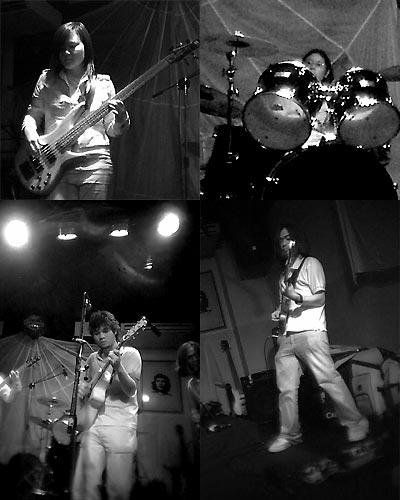
Reza Salleh And The Fumakillas. Clockwise from top-left: Melina, from Tempered Mental; Stephanie, from Ground Xero; Hanafi, who rocked harder than I’ve ever seen than in Estranged, complete with wails and funky space effects; Reza Salleh the acoustic singer-songwriter turned alternative rocker (though was he was from there to begin with? I don’t know.)


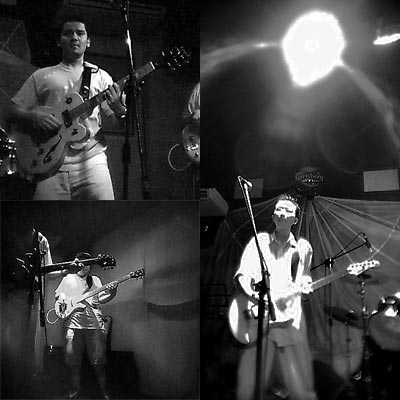
Top-left: Vima of Qings & Kueens, also the funny emcee; bottom-left: Kevin Theseira on bass; right: Paul shreds at the speed of light to their brand of royal rock and roll. (Speaking of which, I prefer their older stuff, which they don’t seem to play anymore.)


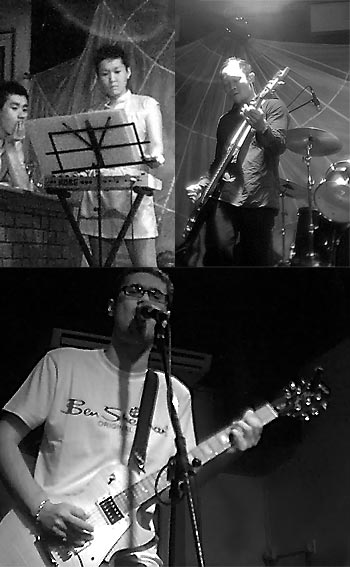
The Great Spy Experiment from Singapore was next. The Strokes and Bloc Party would have been name-dropped by the audience, as they performed solid indie pop. The frontman/guitarist’s strap broke, but he continued rocking, knee bracing his guitar! (Until a strap was lent to him.)

Project Rock-it

Here’s to some oversaturated rock show pictures. Specifically that of Project Bazooka’s, at Laundry Bar, one 21st of September 2006.


Looong exposure, with someone walking past.


Seen a lash? SURE!


Check out the pickguard! Telebury and their jangly indie-pop. The sound does get repetitive after 3 songs featuring those cutesy single-note riffs.


Khai-Lee shows us how to enjoy a rock show; with ease… and slippers.


SingleTrackMind, doing quite a few rock ballad covers.


Solid band, but for some reason did not hit it with the audience.


One Buck Short, a punk rock band I saw the previous Thursday.


Count the frets!

I think I’ve finally honed the gamma levels to look nearly oversaturated, with (darker) dark mids on a CRT monitor at maximum brightness, while looking decently saturated with dark mids looking… dark on a minimum brightness LCD monitor. A compromise between both brightness levels, though technically, my CRT is calibrated properly, and I haven’t figured out how to calibrate correct gamma on the office’s Radeon X300 video cards connected to LCD monitors. Are these pictures too dark/bright for you? Leave a comment.

The Sky Was Blue

…now I am blue.

So these pictures will have to do.

I shall do this in the style of The Pink Frog, with some connectivity in the story.


Remember before the haze?


When you could spot Genting from near my house?


Where KL was clear? (This is Masjid Jamek.)


Colors were nicely saturated (okay so this doesn’t count because it’s indoors.)


Shooting with a polarizer through a car window gave the sky a cheery color!


Crossed polarizers gave Kingsley‘s yard a hint of purple.


But alas! A freakish square-shaped cloud was brewing!


We’re down, dude. No power, dude.


Birds were getting confused by this weather change. “Have you seen my flock?


Grab… my… branch… we… will… survive…


The next day, I found the skies amazingly blue upon coming up the KLCC PUTRA LRT station to take a bus to Bintang Walk. The haze hadn’t kicked in yet.


Finally, somebody appreciates me and doesn’t treat me like a Siamese twin!


Dude, I am your half-brother.


Yes, I was here a while, since the bus drivers were breaking fast and would only resume at 7:30pm.


Coca Cabana!


The Maxis Tower, with the eyelet, reminds me of Quake 1’s grenade launcher for some reason.


And this looks like the Thunderbolt/Lightning Gun, also from Quake 1.


For some reason this looks like it was shot on film.


Fujifilm should pay me. Maybe in ISO400 chrome film. Or a Fujifilm S3 UVIR, which can shoot infrared without modifications.


…or at least in mooncakes. I love mooncakes. This was shot on mooncake festival evening.

Niii Can’t

Little knew that I bought William‘s old Nikon Coolpix 2200 camera to modify, into an auto-focus infrared-enabled camera!

From left to right, top to bottom:

  • The Nikon Coolpix 2200, with 3x zoom and a variety of scene modes e.g. Landscape which would be the closest thing to focus at infinity and a dark aperture.
  • It is also the same size as my Canon Powershot A520. Minus the manual controls, sadly, or even an adjustable ISO sensitivity! I detest Nikon for discarding manual controls on entry-level cameras, when it used to have it.
  • I opened it up, and touched the flash capacitor at least three times, getting a nice numbing zap each time.
  • Spot the SD card slot!
  • The auto-focus gears.
  • The cursed item – the infrared-blocking filter!
  • Upon reassembling, I found it very challenging to reinsert the circuit combs.
  • The optical viewfinder is dusty.
  • The infrared-blocking filter, removed.
  • The tripod mount, plastic, but at least it is not part of the camera. Fazri would appreciate this!

So what happened to it? Why don’t you see me carrying it around?

I killed it. I popped in batteries and a SD card, and it didn’t turn on.

Upon reassembling it, I found two extra pieces that I could not figure where it belonged to/dropped out from. I also had three extra screws!

For some reason, Nikon and I just don’t get along well. I’ve held a Nikon D70s which randomly refused to focus despite having a bright f1.8 lens, and not too dark conditions. I’ve also touched Paul‘s new D80, which had some weird inability to autofocus until he reset something. Not to mention that I am not a fan of the D50’s noise levels, or Nikon’s mellower colors, or the fact that Nikon is not playing catch up or bothering to include newer features the same way Canon did when they came out with the 400D.

At the moment, I guess my manual focus infrared-modded Fujifilm Digital Q1 will have to do.